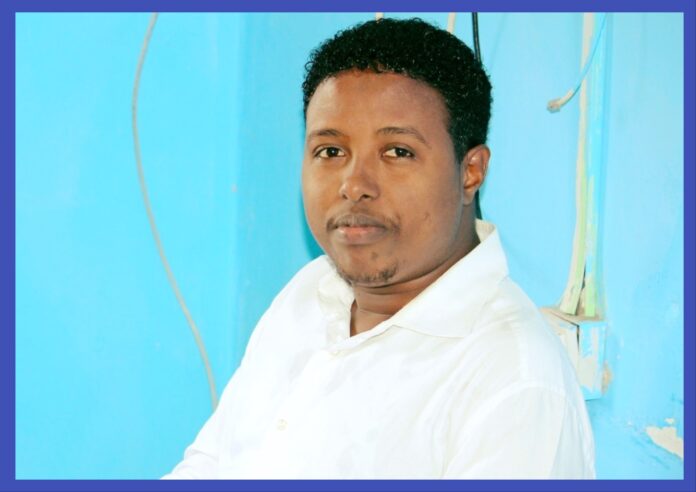
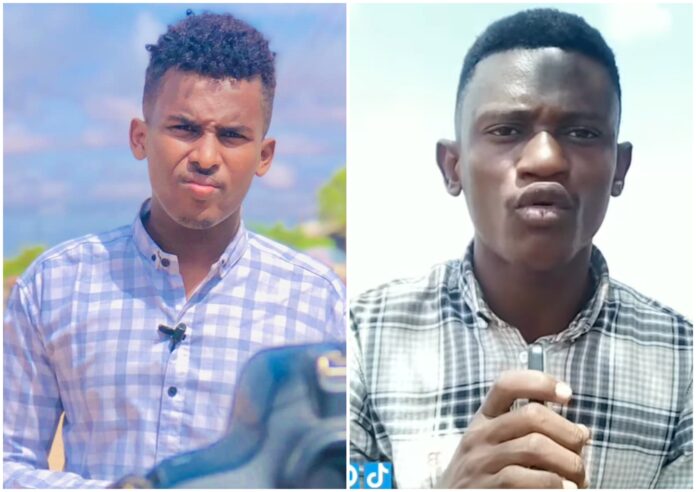
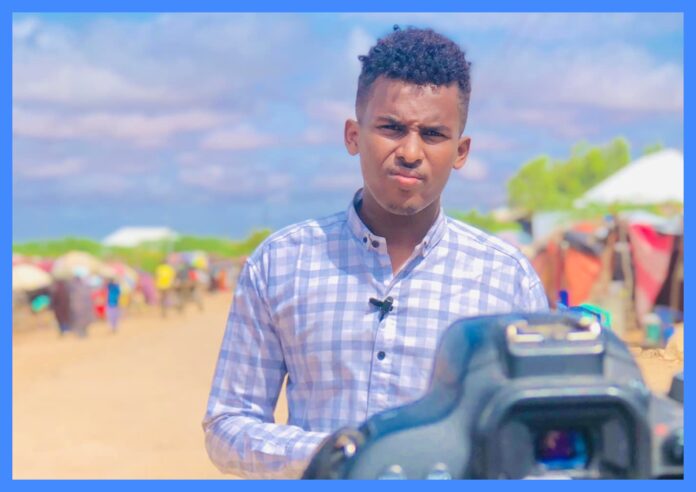
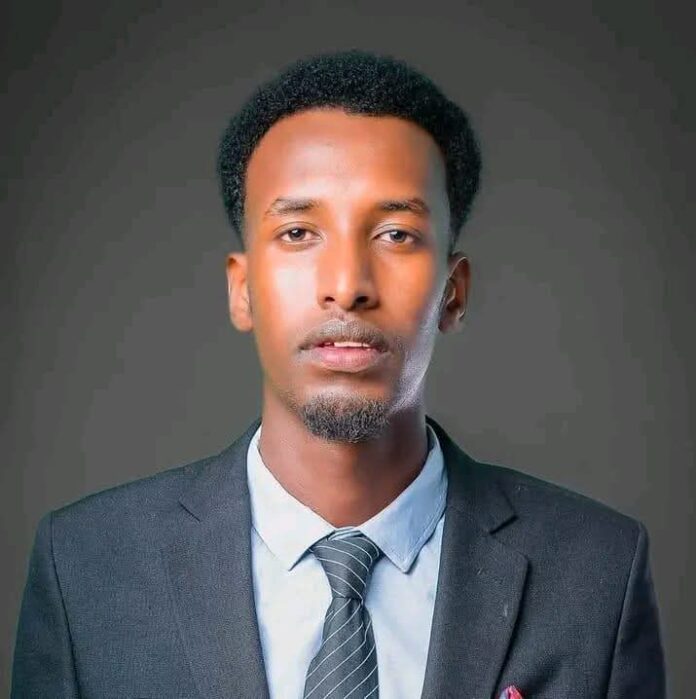
Mohamed Abukar Mohamed (known as Dabaashe), 31 years old, was killed when a massive Improvised Explosive Device explosion hit his residence at the Ceel Gaabta area in Mogadishu, Tuesday 18 March 2025. | PHOTO/Facebook.
MOGADISHU, Somalia – 18 March 2025 – The Somali Journalists Syndicate (SJS) condemns the Al-Shabaab bomb explosion attack that killed a young independent journalist in Mogadishu, Somalia, on Tuesday.
Mohamed Abukar Mohamed (known as Dabaashe), 31 years old, was killed when a massive Improvised Explosive Device explosion hit his residence at the Ceel Gaabta area in Mogadishu. The bomb attack, claimed by Al-Shabaab, had targeted Somali President Hassan Sheikh Mohamud’s convoy.
The president survived; however, several people were killed and others injured, according to media reports.
Dabaashe’s body was found under the rubble of the collapsed building several hours after the explosion, his family and colleagues told SJS.
As a young trainee, Dabaashe joined Radio Risaala in late 2011 and later became a full-time reporter for the station. Since 2019, he had been working as an online reporter, mainly on independent Facebook and YouTube channels.
Dabaashe becomes the first journalist killed in Somalia in 2025. He joins a long list of journalists and media professionals killed in the country since 1992, many of whose cases remain unresolved.
SJS extends the deepest condolences to the family of Mohamed Abukar Dabaashe, his colleagues, and the entire Somali journalist community. His dedication to reporting the truth will not be forgotten, and we stand in solidarity with all journalists who continue to work under extremely difficult and dangerous conditions
“We strongly condemn this heinous attack that claimed the life of journalist Mohamed Abukar Mohamed (Dabaashe). His killing is a tragic reminder of the deadly risks Somali journalists face simply for doing their job,” said SJS Secretary General, Abdalle Mumin.
“I had the privilege of training Dabaashe when he was a junior reporter, and his dedication to journalism was evident from the start. Ensuring the safety of journalists is crucial for press freedom and the public’s right to information. We call for an urgent and independent investigation to hold those responsible accountable and to take concrete measures to protect journalists from violence and intimidation,” adds Mr. Mumin.
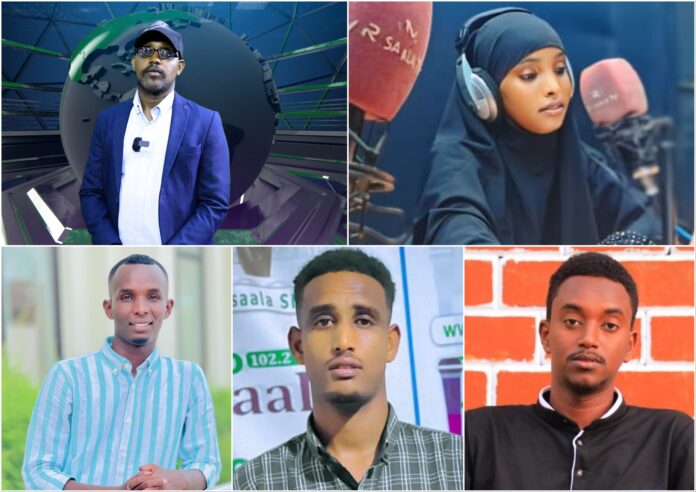
The detained journalists—Ali Ibrahim Abdullahi Suheyfa (reporter), Hamda Hassan Ahmed (female reporter), Mohamed Said Nur (cameraman), Liban Abdullahi Hussein (radio technician), and Abdalla Sharif Ali (cameraman). | PHOTO/Courtesy/ Risaala TV.
MOGADISHU, Somalia – 18 March 2025 – The Somali Journalists Syndicate (SJS) and the Somali Media Association (SOMA) condemn the arrest of five Risaala Media Corporation journalists, who were detained today after Somali police raided and shut down their station in Mogadishu.
Armed police officers, led by their commander Abdi Ali, forcibly entered Risaala Media’s station in the Hamar Jajab district of Mogadishu at midday on Tuesday. They ordered the station off-air before arresting all five journalists present.
The radio station and its affiliated channels, including Risaala TV, went off-air shortly afterward. The detained journalists—Ali Ibrahim Abdullahi Suheyfa (reporter), Hamda Hassan Ahmed (female reporter), Mohamed Said Nur (cameraman), Liban Abdullahi Hussein (radio technician), and Abdalla Sharif Ali (cameraman)—were taken to Hamar Jajab police station where they were put on intense interrogation about their coverage on today’s bombing in Mogadishu.
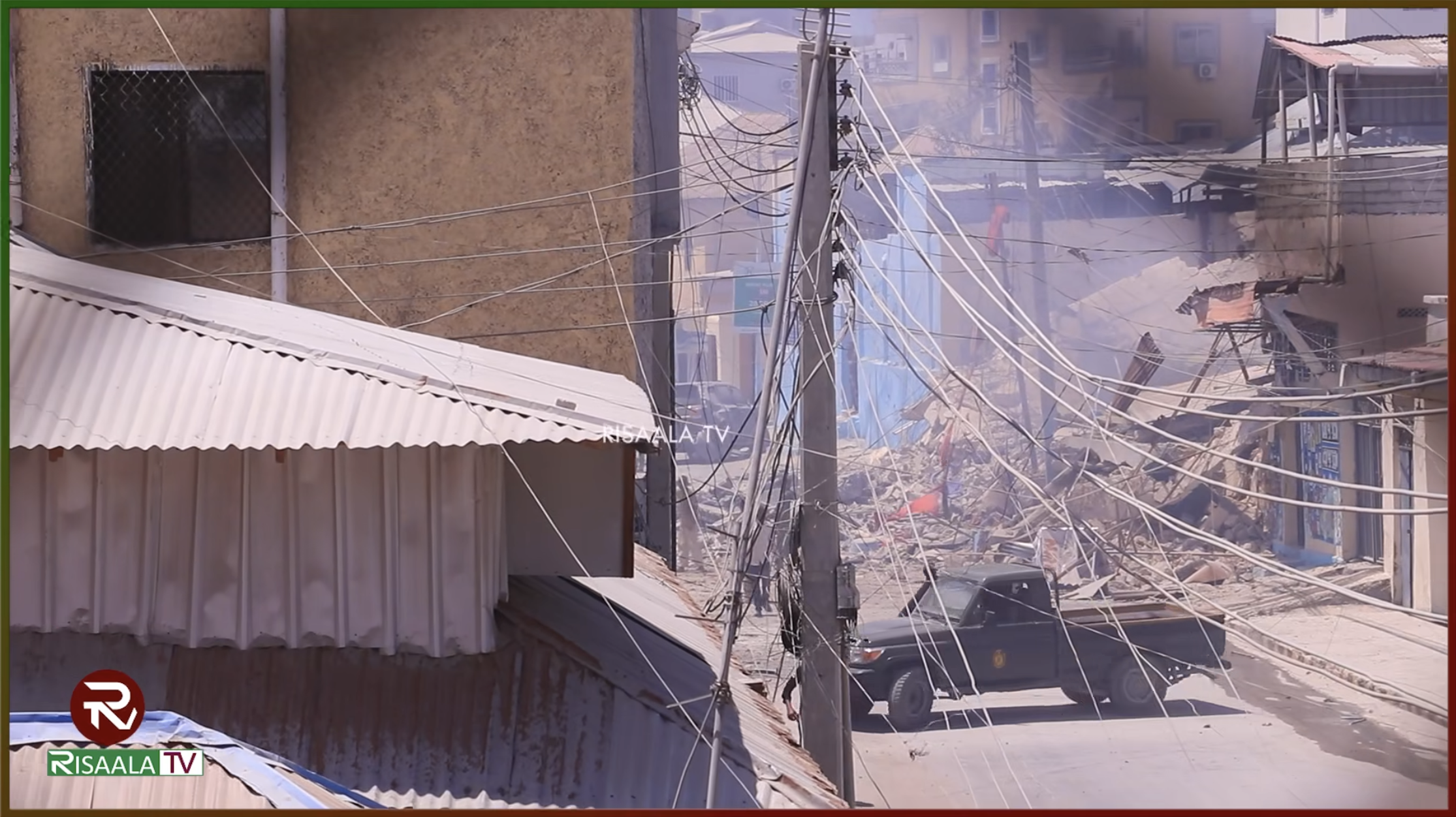
Risaala Media was the first outlet to publish news of Tuesday’s bombing attack targeting Somali President Hassan Sheikh Mohamud’s convoy at the entrance of the presidential palace in Mogadishu, which resulted in casualties.
The journalists said that while in the cell, Banadir Police Commissioner Moalim Mahdi visited them and asked why Risaala reported the bombing attack on the president’s convoy.
As a result of the bombing attack, journalist Mohamed Abukar Dabashe, who previously worked for Radio Risaala, was among several killed. Dabashe becomes the first journalist killed in Somalia in 2025.
Al-Shabaab had claimed responsibility of the attack.
Risaala Media was the first outlet to publish news of Tuesday’s bombing attack targeting Somali President Hassan Sheikh Mohamud’s convoy at the entrance of the presidential palace in Mogadishu. | PHOTO/ Risaala TV/Facebook.
The police officers who raided the station did not have a court warrant. Risaala Media’s management confirmed that the order for the raid and arrests came from Banadir Regional Police Commissioner Mahdi Omar Mumin (popularly known as Moalim Mahdi).
Both Moalim Mahdi and Abdi Ali are former Al-Shabaab defectors who have been incorporated into the Somali police in Mogadishu.
SJS strongly condemns the raid on Risaala Media and the arrest of its journalists. While all five journalists have now been released, SJS demands that Risaala Media and its affiliated channels be allowed to resume their vital role in informing the public.
It is worth noting that this raid and the arrest of Risaala journalists come just a week after Minister of Information Daud Aweis threatened legal action and severe punishment for journalists and media outlets reporting on security failures in Mogadishu, amid growing Al-Shabaab attacks in and around the Somali capital.
“We welcome the freedom of all our colleagues at the Risaala media after they were unlawfully arrested today in Modadishu. This unlawful raid and arrest of journalists for simply doing their job is a blatant attack on press freedom,” said SJS Secretary General, Abdalle Mumin.
“Silencing independent media through intimidation and force only serves to suppress the truth. Independent reporting is crucial for the public to stay informed, hold authorities accountable, and ensure transparency in times of terror attacks. We demand the immediate restoration of Risaala Media and an end to the crackdown on journalists in Somalia,” added Mr. Mumin.
“We strongly condemn the raid on Risaala Media and the detention of five journalists. Such actions undermine press freedom and the vital role of media in informing the public,” said SOMA Secretary General, Mohamed Abduwahab Abdullahi “While we welcome their release, this attack on journalists must not be repeated. Somali government and its police officers must understand that the work of journalists telling the story of what is happening is not a crime.”
Journalist Bahjo Abdullahi Salad spent four hours in police detention and interrogation for exposing the health hazards of government officials' rubbish left in public square in Mogadishu's Wardhigley on Saturday 15 March, 2025. | PHOTO/SJS/ Courtesy.
MOGADISHU, Somalia – 17 March, 2025 – The Somali Journalists Syndicate (SJS) strongly condemns the unlawful detention of journalist Bahjo Abdullahi Salad of RTN TV and the raid on her home, which took place on Saturday, 15 March, 2025, in Mogadishu by members of the Somali National Intelligence and Security Agency (NISA).
Bahjo’s detention followed her reporting on a video exposing rubbish and leftover food dumped in Wardhiigley district. In her report, Bahjo highlighted the health risks posed to the local community, particularly young children, and called on government officials to “clear their rubbish,” according to a video reviewed by SJS. The Somali Prime Minister, Hamza Abdi Barre, had attended the same event, which was intended as a public relations showcase for Mogadishu’s security amid growing public concern over increasing insecurity in and around the capital.
Soon after the clip went viral, NISA officers raided Bahjo’s house and took her to the Wardhigley police station where she spent four hours with police interrogation. She was freed after fellow journalists protested for her freedom.
Bahjo’s arrest is the latest in a wider crackdown on press freedom in Somalia. On 6 March, Somalia’s Minister of Information, Daud Aweys, announced new restrictions on local media houses, journalists, and the general public, barring them from reporting on security failures in the capital.
His statement followed a Somali Cabinet meeting held the same day. Minister Aweys said: “Today, 6th of March, 2025, the Council of Ministers of the Federal Government of Somalia has issued critical decisions, and we urge all Somali citizens to pay close attention. These decisions will result in various legal actions and punishment. As outlined in previous laws and regulations passed by the Council of Ministers, citizens are once again reminded that it is strictly prohibited to misuse or fabricate information—whether directly or indirectly—through any form of media, including social media. Anyone found guilty of such actions will face legal consequences, including prosecution in court and severe punishment in accordance with the law. It is strictly forbidden to broadcast or publish statements or news—whether on social media or radio—that could incite unrest, threaten national security, or spread false information.”
This statement came after the U.S. Embassy in Mogadishu issued a security alert on 4 March 4, stating: “The U.S. Embassy in Mogadishu is tracking credible information related to potential imminent attacks against multiple locations in Somalia, including Mogadishu’s Aden Adde International Airport. All movements of U.S. Embassy Mogadishu personnel have been canceled until further notice.”
Additionally, the U.S. Embassy in Kenya had issued a statement on 27 February, announcing: “The U.S. Government has made the decision to not use Aden Adde International Airport in Mogadishu for official U.S. Embassy Mogadishu travelers until further notice. We will send updates as appropriate.”
These U.S. statements were widely covered by local journalists in Somalia. Following this, several airlines have announced the suspension of their direct flights to Mogadishu.
On 6 March, the Banadir Regional Police Commissioner, Mahdi Omar Mumin (known as Moalim Mahdi), vowed to detain “anyone who reports on security issues in a hot and dark cell with no lights.”
The ban on media reporting about security and threats of arrest and persecution have left residents of Mogadishu—and Somalis in general—in the dark about insecurity issues, even as Al-Shabaab carries out violent attacks near the capital, particularly in Middle Shabelle and Lower Shabelle regions.
“The arrest of journalist Bahjo Abdullahi Salad and the escalating threats against independent media coverage in Somalia are blatant attacks on press freedom. Targeting journalists for reporting on public health hazards and security concerns is not only unlawful but also deeply concerning,” said Abdalle Mumin, the Secretary-General of the Somali Journalists Syndicate (SJS).
“The media plays a crucial role in informing the public about what is happening on the ground. Silencing journalists and imposing restrictions on reporting security failures will only worsen the situation, leaving citizens in the dark and enabling impunity,” Mumin added, “We urge the Mogadishu authorities to respect press freedom and the right of the Somali people to access truthful and timely information.”
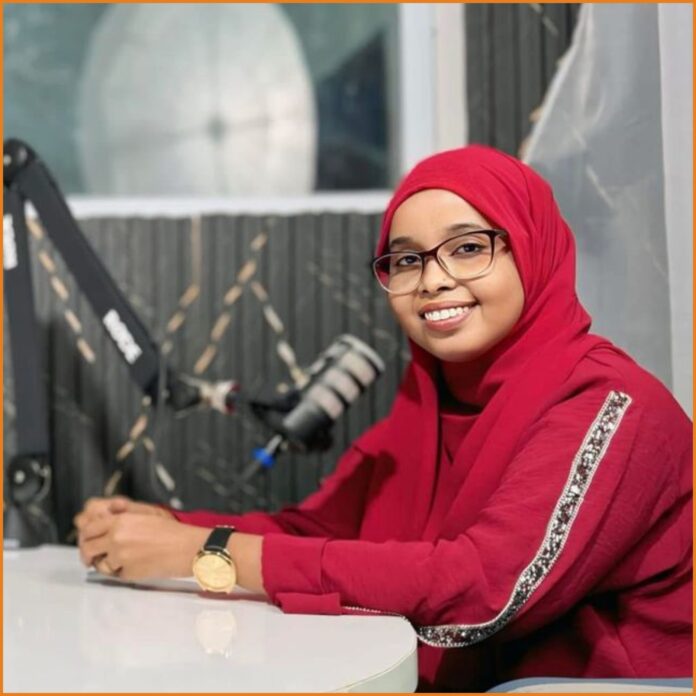
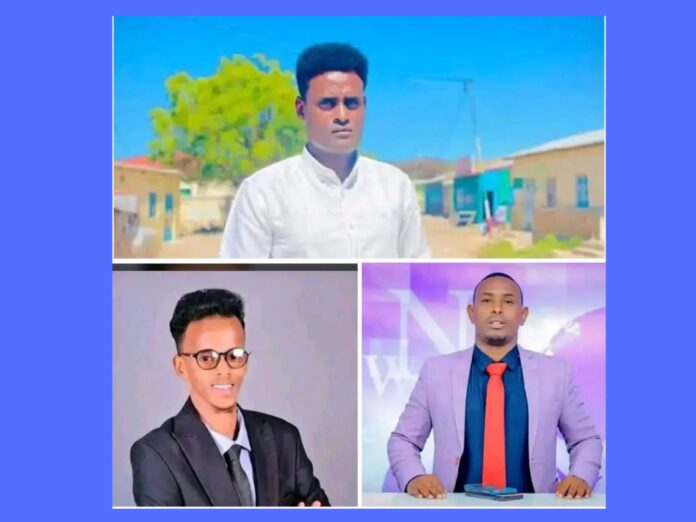
(From top to bottom left): Said Ali Osman (Said Xaaleys) of Sky Cable TV, Ayanle Ige Duale of Sahan TV, and Abdiasis Saleban Sulub of KF Media. | PHOTO/SJS/Courtesy.
MOGADISHU, Somalia, 4 March 2024 – The Somali Journalists Syndicate (SJS) calls on the Somaliland authorities to lift the ongoing ban on Universal TV and to stop detaining journalists who scrutinize government officials, while also urging Somalia’s Southwest State officials to allow independent media to report on issues of public interest.
On 27 February, authorities in Somalia’s Southwest State ordered three local media stations—Arlaadi Media, Voice of Baay and Bakool, and Radio Warsan—to halt their planned Ramadan radio contest, which was scheduled to start on Saturday, 1 March. The official who issued the directive was Isak Hassan Mohamed, who was then the chairman of the youth committee for the Baidoa district administration but has since been promoted to a member of the Southwest State Assembly, during an appointment on 27 February.
The three media representatives told SJS that no reason was provided for the order, except that the district official complained that the “Ramadan contest was organized without his knowledge.” Mr. Isak did not respond to SJS when contacted for clarification. However, SJS was informed by officials at the Southwest State media that a separate Ramadan radio contest had been organized by the state media.
Sources SJS spoke to suggested that the independent media contest might have attracted a larger audience, which concerned the authorities, as it could lead to a decline in state media listenership.
The issue was later resolved, and the three media houses informed SJS that they have since begun the contest without further restrictions on Saturday 1 March.
Meanwhile, the Southwest State is reportedly preparing for its upcoming elections, though no date has been set. On 27 February, the regional assembly re-elected Dr. Ali Said Faqi as its Speaker of Parliament, while 11 members of the regional assembly were replaced. Independent media coverage was blocked during these activities, with only state-owned media being allowed to report.
On 25 February, Somaliland’s Togdheer Governor, Mohamud Ali Saleban (Ramaax), ordered the detention of three local journalists in Burao: Said Ali Osman (Said Xaaleys) of Sky Cable TV, Ayanle Ige Duale of Sahan TV, and Abdiasis Saleban Sulub of KF Media. Said Ali Osman was detained after interviewing Governor Ramaax on the same day and asking about his relationship with local clan militias in the region. During the interview, the governor was seen walking away from the camera in protest of the question, which he did not answer.
Said Ali Osman was detained after interviewing the Governor of Togdheer, Mohamud Ali Saleban (Ramaax) and asking about his relationship with local clan militias in the region on 25 February, 2025. | PHOTO /Screenshot/SKY Cable TV Facebook.
The clan militia groups, known locally as SSB and G36, which were involved in recent conflicts in the Sanaag and Sool regions, were reportedly integrated into the Somaliland army following an announcement by President Abdirahman Irro.
Ayanle Ige Duale and Abdiasis Saleban Sulub were detained after publishing reports on their respective Facebook accounts alleging that “the Togdheer regional administration and other officials had used bulldozers to destroy water reservoirs, claiming they were demolishing illegally occupied land”. The journalists further alleged that, “while rural areas of the Togdheer region were suffering from severe drought and widespread water shortages, the authorities responsible for water provision were instead destroying the very sources that the thirsty population relied on”.
According to the detained journalists and others who spoke to SJS, the three journalists were released after spending 24 hours in Burao police cells. They were not charged.
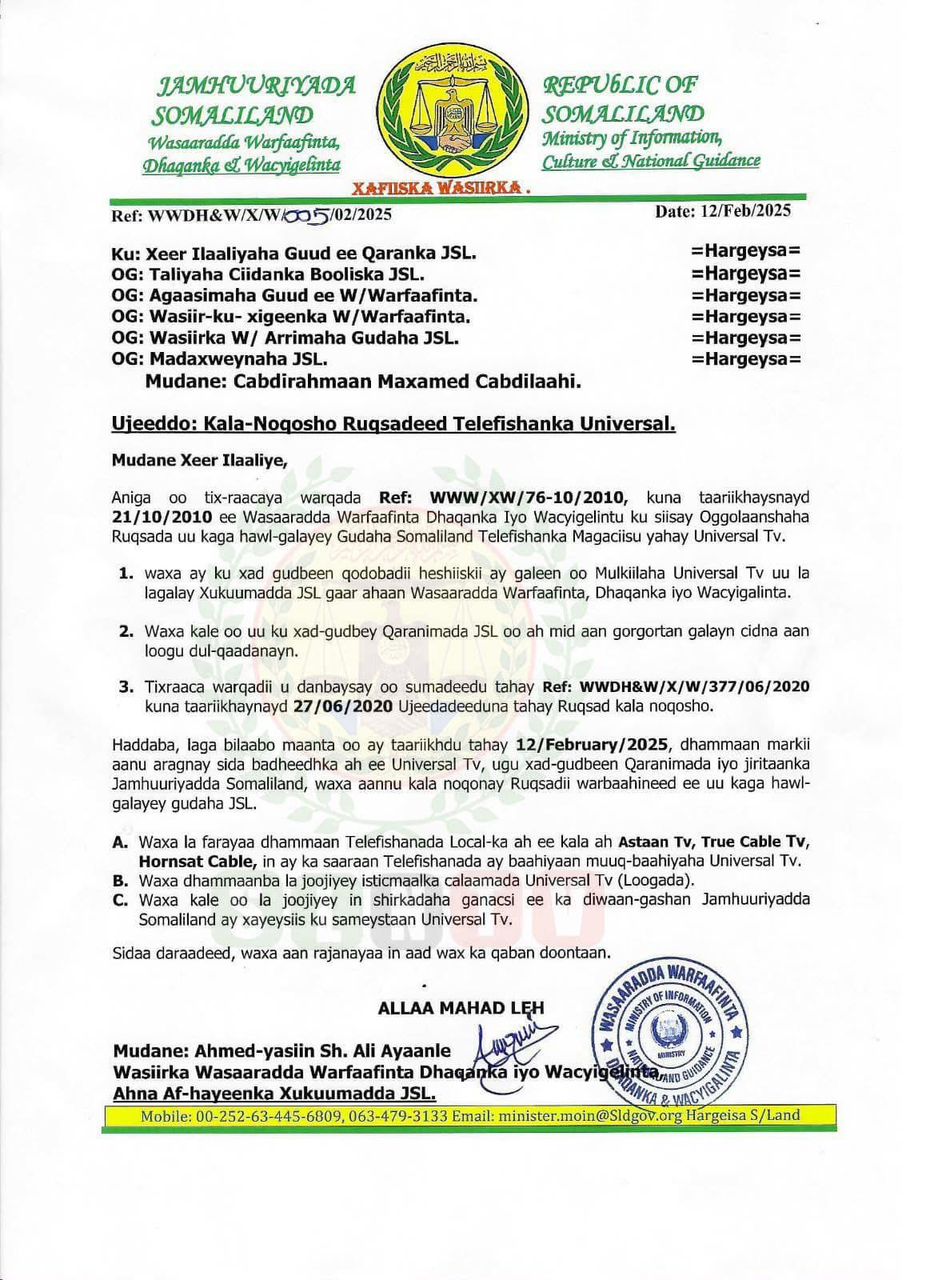
On 12 February, Somaliland’s Ministry of Information, Culture, and National Guidance ordered the closure of the privately-owned Universal TV in Somaliland following a news report on 11 February about Somaliland President Abdirahman Abdillahi Irro’s visit to the United Arab Emirates (UAE), where he attended the World Governments Summit in Dubai reiterating Somaliland’s ambition for international recognition.
In the Universal TV report reviewed by SJS, the journalist raised the issue of Somaliland’s unrecognized status and suggested that President Irro’s invitation to the UAE could be interpreted as a “breach of Somalia’s territorial integrity.”
The ministry’s directive signed by Somaliland’s Minister of Information, Ahmed-Yaasin Sheikh Ali Ayanle, which SJS had seen had accused Universal TV of “violating the agreement the television management had entered with Somaliland” and that they had breached “Somaliland’s nationhood.” As a result, the ministry ordered all cable networks to remove Universal TV from their listings, banned the use of its logo, and instructed local advertisers to terminate all advertising agreements with the station.
On 12 February, Somaliland’s Ministry of Information, Culture, and National Guidance ordered the closure of the privately-owned Universal TV in Somaliland following a news report about Somaliland President Abdirahman Abdillahi Irro’s visit to the UAE.
Universal TV representatives told SJS that the station remains closed in Somaliland as of 4 March, and that their journalists are unable to work from within Somaliland.
The ban on Universal TV appears to be a punitive measure against its editorial stance, as Somaliland authorities have shown a clear lack of tolerance for critical media coverage. On 6 January, 2024, Somaliland security forces raided the offices of MM TV in Hargeisa during a live broadcast discussing the Somaliland-Ethiopia Memorandum of Understanding (MOU). The raid involved the use of physical violence against journalists and staff, resulting in the detention of MM TV founder Mohamed Abdi Ilig, reporter Mohamed Abdi Abdullahi (Andar), and cameraman Ilyas Abdinasir.
“SJS calls on Somaliland authorities to allow Universal TV to resume operations and stop punishing independent media, such as Universal TV and others for their editorial choices. We also urge Somaliland to stop detaining journalists simply for asking critical questions to officials,” said SJS Secretary General Abdalle Mumin.
“We also call on Southwest State to create space for independent media ahead of its reportedly planned elections. Authorities in Baidoa must recognize the crucial role independent media plays in fostering transparency and accountability within society,” Mr. Mumin adds.
Deputy Minister Abdirahman Al-Adaala threatens journalist Mohamed Abduqadir Hajir as he halts critical questioning during a press conference by government ministers in Mogadishu on Saturday, February 8, 2025. | PHOTO: Screengrab from RTN TV video clip/SJS.
MOGADISHU, Somalia 10 February 2025 – The Somali Journalists Syndicate (SJS) strongly condemns the harassment, obstruction of access to information, and threats against journalists covering security and other public interest matters in Mogadishu. SJS calls for an immediate investigation into the actions of Somalia’s Deputy Minister of Information, Abdirahman Yusuf Omar Al-Adaala.
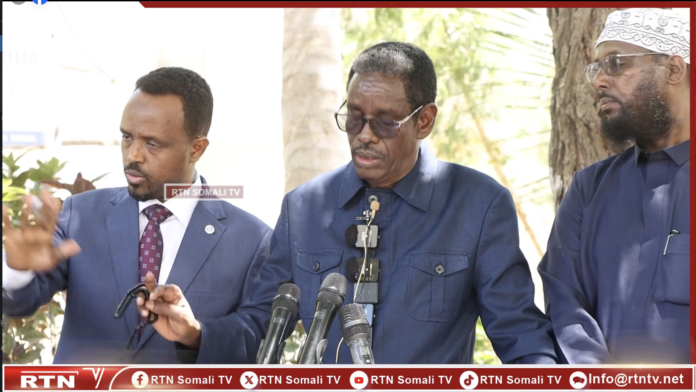
On Saturday, February 8, 2025, journalists from a dozen of media houses were invited to cover a joint press conference featuring Minister of Security General Abdullahi Sheikh Ismail Fartaag, Minister of Religious Affairs Mukhtar Robow Ali, and Attorney General Sulayman Mohamoud. During the briefing, RTN TV journalist Mohamed Abduqadir Hajir raised critical questions regarding the closure of major business hubs in Mogadishu due to escalating insecurity and alleged ‘extortion’, a concern publicly raised by the business community in a 7 February communiqué. This widespread market closure had paralyzed economic activity in the capital.
When RTN TV journalist Hajir directed his questions to the Minister of Security, Deputy Minister Al-Adaala interrupted with harassment and humiliation telling him publicly “to stop” and that he “should not ask such questions”. Shortly afterward, a security officer stepped forward, removed journalists’ microphones from the podium, and cut off the recording.
A security officer stepped forward, removed journalists’ microphones from the podium, and cut off the recording. | PHOTO/Screengrab from RTN TV video clip.
This incident follows a pattern of intimidation against the same RTN TV journalist. Late January, Hajir and his team were harassed and threatened with detention after interviewing a police officer who spoke out about the demolition of his family’s home and his inability to relocate due to unpaid salaries. The police officer was among thousands of vulnerable residents at the ex-Carwada Qaranka site, Mogadishu, who were forcibly evicted by the government in collaboration with Premier Bank.
As a result of these threats, RTN TV was forced to delete the interview, although it was later republished by other platforms.
Similarly, Radio Risaala’s management informed SJS that their journalists have faced continuous threats and bans from public offices by Abdirahman Al-Adaala, who has abused his authority as Deputy Minister of Information. The Ministry of Information even refused to renew Radio Risaala’s registration, forcing the station to seek registration from another government ministry.
Additionally, the Somali Media Association, which represents 33 independent media houses nationwide, reported that Al-Adaala has targeted them with similar restrictions.
On 3 December, 2024, under Al-Adaala’s orders, the Director General of the Ministry of Information, Abdullahi Hayir Duale, mandated that all journalists working for international media outlets register with the ministry. This directive, framed as a “safety and security procedure,” was rejected by SJS and its members as a direct threat to independent journalists covering public interest issues, including security operations, human rights and corruption.
The repression of journalists under Al-Adaala’s leadership has extended to state media reporters as well. In April 2024, state media journalist and presenter Sugaal Moalim Mohamud was suspended, and his salary was halted in retaliation for his reporting on mismanagement and corruption within the Ministry of Defense. Sources within the ministry confirmed to SJS that the decision, carried out by Director General Duale, was ordered by Al-Adaala.
Similarly, in July 2024, state media journalist Abdulkadir Isse Ali was dismissed, blocked from accessing the state media, and had his salary cut after publishing a report exposing alleged fraud and corruption involving Al-Adaala. Days later, his Facebook account was restricted under a copyright claim, prompting SJS to intervene. Both Sugaal and Abdulkadir have previously received threats from Al-Shabaab due to their roles in state media, and their dismissal further endangered their safety.
The crackdown on press freedom is not new. In October 2022, officers from the National Intelligence and Security Agency (NISA) raided the SJS office in Mogadishu and abducted SJS Secretary General Abdalle Mumin. This attack came after Al-Adaala issued a directive aimed at restricting media freedom, prompting SJS and four other press freedom organizations to voice their concerns, despite Al-Adaala threatening to target SJS in a phone call to the SJS leadership on the same day.
Since 2022, SJS has continued to recognize Abdirahman Al-Adaala as the worst violators of press freedom in Somalia, citing his ongoing threats, intimidation, and attacks, and calls for immediate accountability for his actions.
In July 2019, two non-profit media organizations had their names published online by the state media following a letter signed by Al-Adaala, accusing the institutions for “violating the national plan, public culture, religious and customs”.” This accusation of “violating religious customs” was enough to endanger the local staff of both organizations in Somalia. The two organizations later told SJS that they were forced to pay bribes to Abdirahman Al-Adaala, who was then acting director general of the Ministry of Information, in order to continue operating, despite being legally registered and the accusations being false. Eight days later, the Ministry of Information published another directive announcing its approval for the two organizations.
“We strongly condemn the actions of Somalia’s Deputy Minister of Information, Abdirahman Al-Adaala, and his ongoing efforts to stifle press freedom in the country. These continued attacks are not only a violation of journalists’ rights but also an affront to the truth and the public’s right to know. Al-Adaala’s actions are endangering the security of already vulnerable journalists and their families. We call for immediate accountability and demand that Al-Adaala be held responsible for his threats and actions against the media,” said SJS President Mohamed Ibrahim
“The Somali government must ensure that those who target journalists, like Al-Adaala, are held accountable, and the rights of the press are protected at all costs. We also call on the international community to hold Al-Adaala accountable and to support efforts to safeguard media freedom and human rights in Somalia,” added Mr. Ibrahim
Journalists Sharif Abdi (pictured left, and Omar Guux (right) were freed after they were illegally held by NISA in Mogadishu and a clan militia in Lower Shabelle respectively. | PHOTO/SJS/ Courtesy.
MOGADISHU, Somalia 10 February 2025 – The Somali Journalists Syndicate (SJS) is relieved that journalist Sharif Abdi, who was illegally detained by the Somali National Intelligence and Security Agency (NISA) in Mogadishu, and Omar Yusuf Mohamed (Omar Guux), who was held by a clan militia in Lower Shabelle, have been freed and are now back with their families after enduring horrific experiences in detention.
On 9 February 2025, freelance journalist Sharif Abdi, who had been held without a court order by NISA since 25 January 2025, was released. Sharif was kidnapped from Mogadishu’s city center on the night of 25 January by armed NISA officers who tracked his phone, just hours after his home in Waberi district was raided.
He was held and interrogated at Godka Jilaow, NISA’s notorious torture and detention facility at Boondheere neighborhood. According to Sharif and other sources interviewed by SJS, his repeated interrogations focused on his critical reporting on Facebook, particularly posts criticizing NISA chief Abdullahi Mohamed Ali (Sanbalolshe) who holds Somali and British citizenship.
For 10 days, Sharif was confined in a narrow, dark, and hot cell with 20 other inmates, including Al-Shabaab suspects. After 10 days, NISA resumed questioning him, focusing on his recent posts about the NISA chief’s trip to the Hiiraan region, where inter-clan conflicts have affected local communities.
On Sunday afternoon, Sharif was called by officers who informed him that his detention was meant to “discipline him and make him soft so that he won’t write critically in the future.” NISA agents then drove him to the Habar Khadijo building in Shibis district, where he briefly met the NISA chief, Mr. Sanbalolshe. At the meeting, the NISA chief warned him against posting critically in the future before releasing him.
On Friday, 7 February, a government-affiliated clan militia in Lower Shabelle kidnapped journalist Omar Yusuf Mohamed (Omar Guux), who reports for Nabad Somali TV, a Facebook-based news platform. Omar was covering local community complaints about militia raids and detentions targeting civilians in and around KM50, Lower Shabelle region.
Omar Guux told SJS that he was locked in an abandoned makeshift house in KM50 before being freed late on the same Friday. He said the militia interrogated him about his report on the disappearance of a local clan elder, who was taken after the militia raided his home on 31 January.
SJS condemns these horrific attacks on journalists in Mogadishu and Lower Shabelle. We call on all parties to respect press freedom and the independence of journalists, including those exposing NISA’s abuses and the crimes of government-affiliated militias.
“The arbitrary detention and intimidation of journalists like Sharif Abdi and Omar Guux highlight the ongoing threats to press freedom in Somalia. No journalist should be kidnapped, tortured, or threatened for simply doing their job,” said SJS Secretary General, Abdalle Mumin.
“We strongly condemn these acts and demand accountability for those responsible. The authorities must take concrete steps to investigate these violations, hold the perpetrators—whether state security agents or clan militias—accountable, and ensure the safety of all journalists. Press freedom cannot exist where impunity prevails,” Mr. Mumin added.
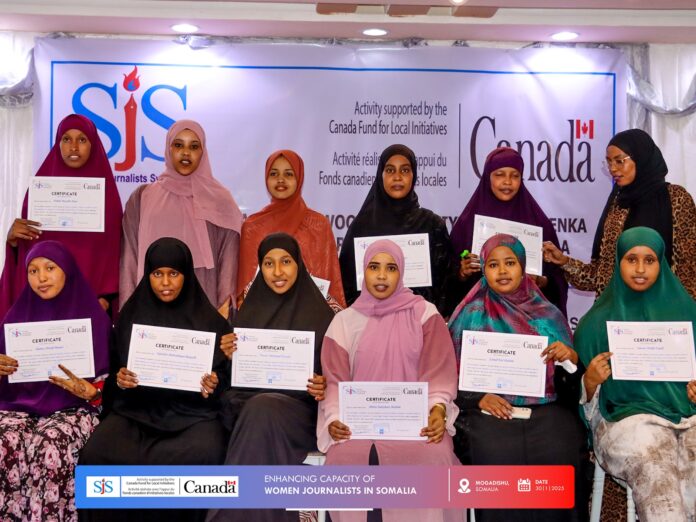
Training participants pose for a group photo during the end of the SJS women journalists training in Mogadishu on 30 January, 2025. | PHOTO/SJS.
MOGADISHU, Somalia – 6 February, 2025 – The Somali Journalists Syndicate (SJS) has successfully concluded another round of training aimed at empowering women journalists in Somalia.
This initiative, supported by the Canada Fund for Local Initiatives (CFLI), seeks to enhance the skills and awareness of female reporters, particularly in documenting and reporting human rights issues.
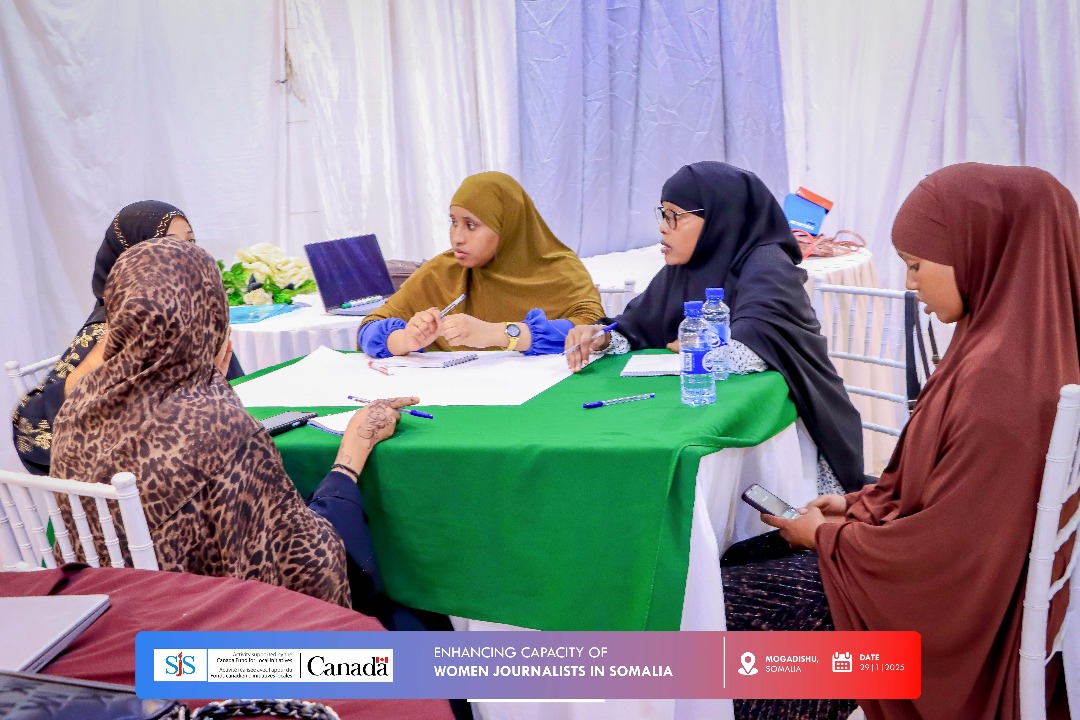
Between January 29–30, SJS hosted 10 women journalists from Mogadishu, Hirshabelle, Southwest State, and the Gedo region for an intensive two-day workshop in Mogadishu.
The training focused on improving safety and security measures, producing high-quality journalism on gender-related issues, and amplifying the voices of marginalized communities.
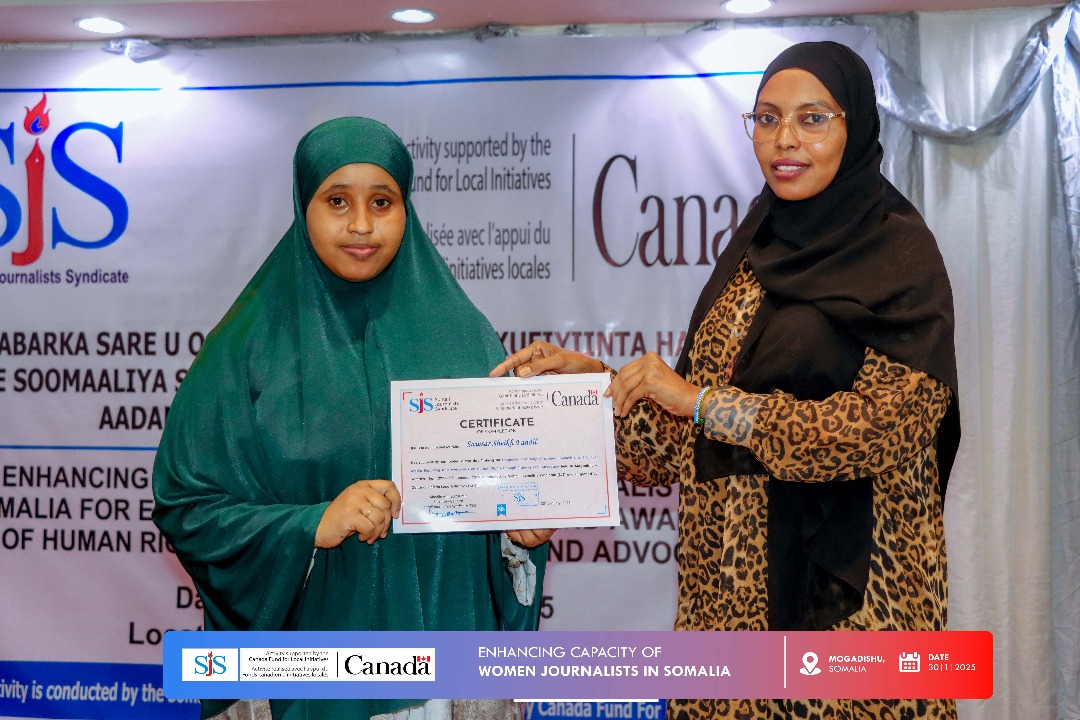
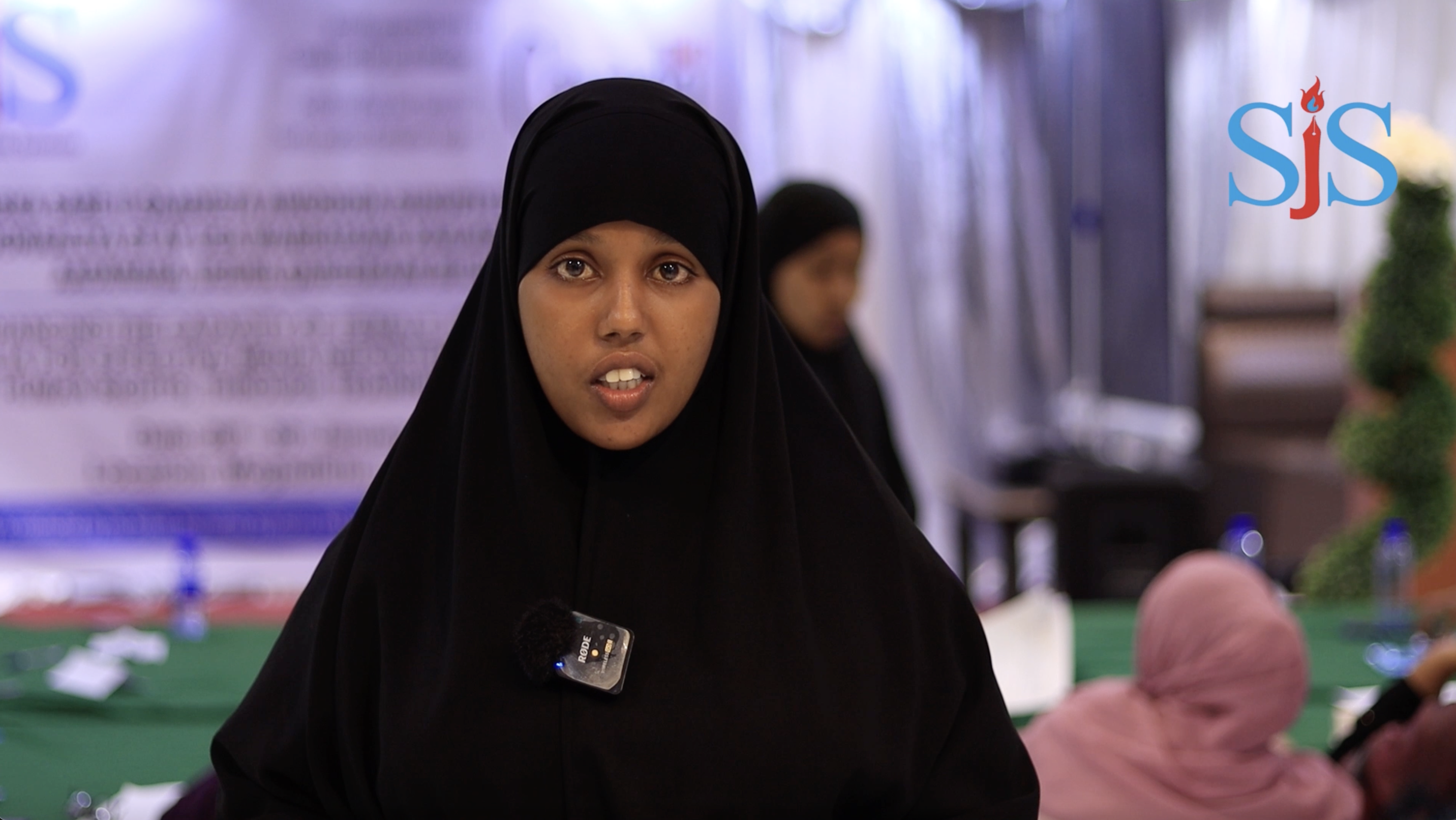
Sawsar Sheikh Faadil, a journalist with RTN TV Mogadishu, highlighted the importance of the safety protocols covered during the training.
“For me, security was a major concern. As a female reporter who goes out every day in search of stories, I benefited greatly from learning the necessary safety and security protocols,” she said. “I am grateful to the trainers and hope for more training opportunities in the future.”
Sawsar Sheikh Faadil (left) receuves her certificate from SJS trainer Halima Abdullahi (right) during the end of a two-day journalists training in Mogadishu, on 30 January, 2025. | PHOTO/SJS.
SJS put significant effort into selecting participants who would benefit the most from this program, particularly those from marginalized communities and conflict-affected regions.
Overcoming Challenges in Conflict Zones
Kawsar Abdirahman Barkhadle, a reporter from Radio Gedo, traveled to Mogadishu for the training despite the ongoing conflict between Jubaland state authorities and the federal government. Her hometown, Beled-Hawo, like many in Gedo, remains under threat from Al-Shabaab militants, posing severe risks to journalists.
Being a female journalist comes with additional risks in Somalia’s patriarchal society, where women are often discouraged from pursuing male-dominated careers.
Kawsar Abdirahman Barkhadle, a reporter from Radio Gedo, traveled to Mogadishu for the training. | PHOTO/SJS.
“When I started as a radio presenter in 2021, my parents urged me to quit. Society still struggles to accept women in certain professions,” Kawsar explained. “This training equipped me with advocacy skills, and I urge SJS to expand these sessions to reach more women in remote areas.”
Nurto Mohamed Hussein, a Radio Warsan reporter from Baidoa, said the training allowed her to connect with other female journalists and exchange experiences.
“During the workshop, I networked with women reporters facing similar challenges—low pay, safety concerns, and working in male-dominated media houses,” Nurto said.
During the training, Nurto took the opportunity to interview fellow participants, documenting their struggles in a report later published by Kaab TV.
Nurto Mohamed Hussein, a Radio Warsan reporter. | PHOTO/SJS.
In addition to hands-on training, SJS mentors journalists in developing impactful stories about their communities. When newsroom editors dismiss such stories, SJS advocates for their publication.
“This training program has been one of our biggest achievements since 2021, thanks to CFLI’s continued support,” said SJS Secretary-General Abdalle Mumin. “Changing the status quo for women journalists takes time and persistence. That’s why we must sustain and build on these efforts.”
Women make up 20% of Somalia’s professional journalists and are among the lowest paid, often earning less than their male counterparts for equal work. Many lack essential skills such as video and audio editing and access to equipment like computers, cameras, and voice recorders, making them more vulnerable to exploitation including sexual advances and harassment.
“When we listen to our female trainees, they share painful experiences of harassment and challenges in performing their duties,” SJS Secretary General Mumin said. “That’s why SJS has rented a studio and provided equipment for women journalists to produce their own stories. We are proud to support vulnerable female reporters and will continue these efforts.”
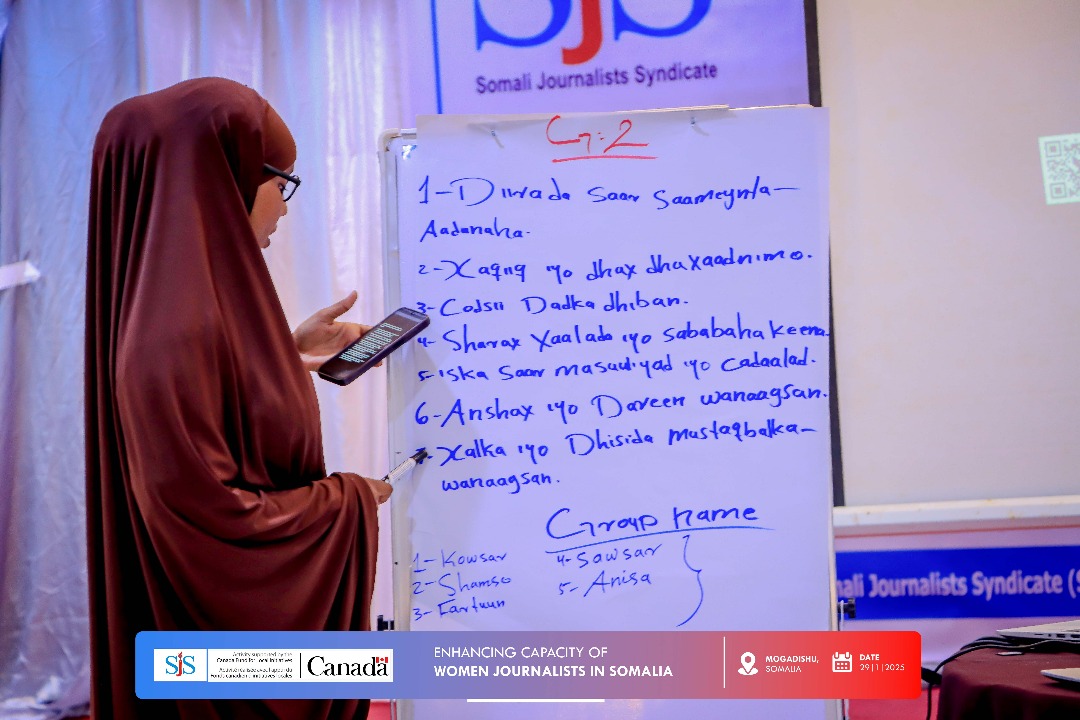
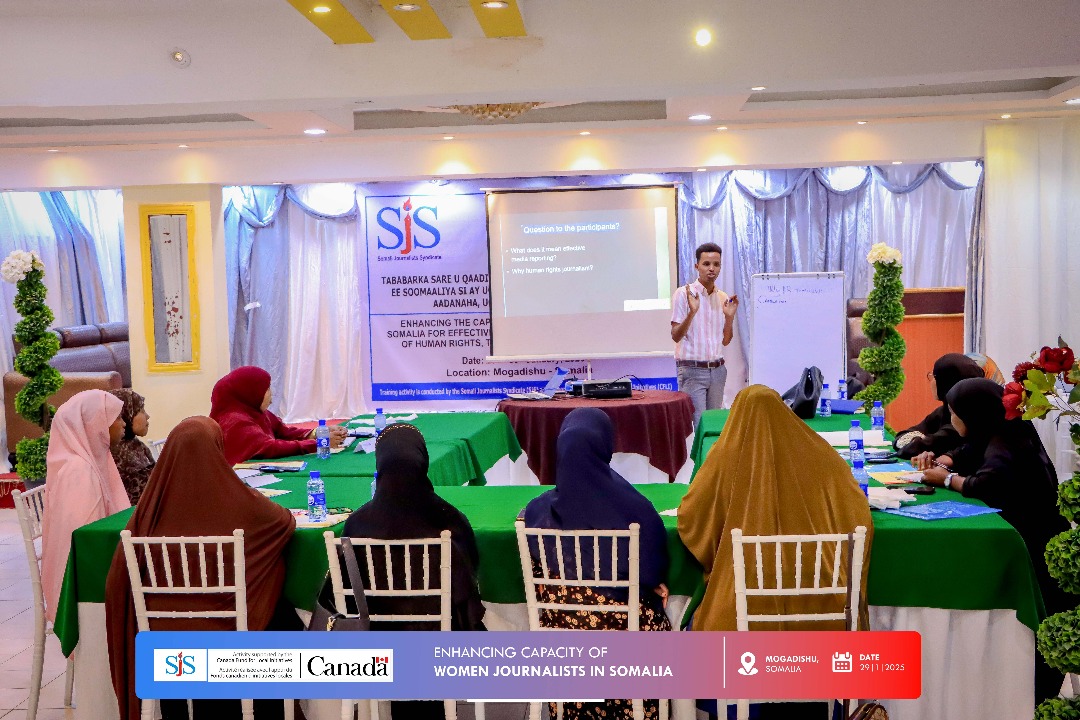
Training participants engage a group discussion. |PHOTO/SJS.A training participant makes presentation during the second day of the training. | PHOTO/SJS.Training participants attend a session on day 1. | PHOTO/SJS.
Journalist Sharif Abdi is detained without a court order by the Somali national intelligence agency (NISA) in Mogadishu since January 25. | PHOTO/Courtesy/SJS.
MOGADISHU, Somalia, 02 February, 2024 – The Somali Journalists Syndicate (SJS) calls on Somalia’s National Intelligence and Security Agency (NISA) to release freelance online journalist Sharif Abdi, who has been detained without a court order by NISA since 25 January 2025.
On the night of Saturday, January 25, armed NISA officers raided the home of Sharif Abdi in Mogadishu’s Waberi district.
However, family members told SJS that the officers began tracking him after failing to find him at his residence.
Later that evening, NISA officers detained the journalist at another location far from his home.
A family member and one of Sharif’s colleagues told SJS that the NISA officers who detained him were using a mobile tracking device to locate him.
SJS has been informed that the journalist was taken to the notorious NISA detention and torture facility known as Godka Jila’ow in Mogadishu, where he is currently being held.
Family members attempted to visit him but were denied access, leaving them unaware of his safety and well-being.
Sharif, who uses Facebook for his reporting, primarily covers security operations in the Hiiraan region, central Somalia, where he hails from.
In his reports reviewed by SJS, Sharif has been critical of NISA Director Abdullahi Mohamed Ali (Sanbalolshe).
In his last report, published on Saturday, January 25, before his arrest, Sharif discussed the rift between the NISA chief and local clan elders in Hiiraan regarding a planned military operation against Al-Shabaab.
The region has recently witnessed increased inter-clan conflict amid the ongoing Al-Shabaab threat.
A government source told SJS that NISA officials were angered by the journalist’s report, prompting NISA Chief Mr. Sanbalolshe, who also doubles as a member of parliament, to order his arrest.
“We strongly condemn the unlawful and continued detention of journalist Sharif Abdi. His arrest is yet another attack on press freedom in Somalia and it poses a threat to wider journalist community who cover issues about security operations and the conflict,” said SJS Secretary General, Abdalle Mumin.
“We call on NISA officials to release Sharif Abdi unconditionally and to end their harassment of journalists who are critical of them and other government officials.”
MOGADISHU, Somalia, 31 January 2025 – The Somali Journalists Syndicate (SJS) is pleased to announce its successful membership in the Casualty Recorders Network, a global community of organizations dedicated to documenting casualties.
As part of its commitment to human rights and press freedom in Somalia, SJS records casualties, including those of journalists.
By joining this global network of like-minded organizations, SJS aims to highlight the systematic attacks on freedom of expression and the broader human rights violations in the country. This includes shedding light, through SJS network of human rights journalists, on casualties among minority communities and marginalized groups, whose suffering often goes unreported.
SJS Secretary General Abdalle Mumin hailed this as a significant achievement for both SJS and the Somali journalism community in 2025.
“The Casualty Recorders Network serves as a vital platform for organizations to exchange knowledge, support one another, and collaborate on research and advocacy initiatives. By joining this network, SJS gains valuable opportunities to enhance its capacity while also amplifying the plight of journalists in Somalia, who endure persistent threats yet often go unnoticed,” said Mr. Mumin.
The Casualty Recorders Network members benefit from access to specialized resources, peer-to-peer training programs, expert-led webinars, and ad-hoc advisory support.
Additionally, they have opportunities to participate in Human Rights Council sessions and other United Nations events, facilitated by Every Casualty Counts, which holds ECOSOC Special Consultative Status.
One of the network’s primary objectives is to enhance the quality and impact of casualty recording efforts worldwide by promoting standardized methods for documenting and verifying casualty data—an area in which SJS is actively striving for improvement.
“By highlighting these violations, SJS seeks to amplify the voices of the media community and those who are often overlooked. We are pleased to join the Casualty Recorders Network and look forward to making meaningful contributions,” Mr. Mumin concluded.
Jjournalist Shafi’i Abdi Mohamed (commonly known as Sha’iye), who had been detained in Hargeisa since Thursday, 16 January 2025. | PHOTO/ SJS / Courtesy.
MOGADISHU, Somalia, 22 January 2025 – The Somali Journalists Syndicate (SJS) welcomes the release of journalist Shafi’i Abdi Mohamed (commonly known as Shaaciye), who had been detained in Hargeisa since Thursday, 16 January 2025.
On 16 January, Shaaciye, a journalist known for his critical posts about Somaliland authorities on Facebook, was arrested upon his return to Hargeisa from Mogadishu, where he had resided for a year.
Local journalists informed SJS that Somaliland police raided his home and arrested him following orders from Somaliland Police Commander Mohamed Adan Saqadhi.
Somaliland police officials have not commented on the circumstances surrounding Shaaciye’s detention.
Shaaciye had previously fled Hargeisa, citing threats from Somaliland’s national intelligence due to his critical posts. He spent nearly a year in Mogadishu.
During his time in Mogadishu, Shaaciye continued his journalistic work, frequently posting on Facebook and other platforms, including reports highlighting police corruption and public complaints about the Somaliland police commander.
On 18 January, Shaaciye was reportedly brought before the Maroodi Jeh Court in Hargeisa, where his detention was extended for a week.
On Wednesday, 22 January, he was released from police custody after the intervention of clan elders and on a condition that he refrains from criticizing the police, local journalists and a family member told SJS.
SJS expresses relief at Shaaciye’s release and calls on Somaliland President Abdirahman Abdillahi Irro to ensure that security officials refrain from targeting journalists and media workers who critique the government.
“While we welcome Shaaciye’s release, we strongly condemn the raid on his home and his unjust detention on 16 January, which caused him to spend a week in custody,” said SJS Secretary General Abdalle Mumin.
“Since President Abdirahman Irro’s election victory in November last year, there has been a sense of renewed freedom and safety among journalists and others who had previously fled Somaliland. It is crucial for Somaliland authorities to uphold this atmosphere and honor the president’s campaign promise that no one would be targeted for exercising their freedom of expression,” Abdalle Mumin added.