Home Blog Page 38

On IDEI, Somali journalists and their unions call for urgent end of impunity

0
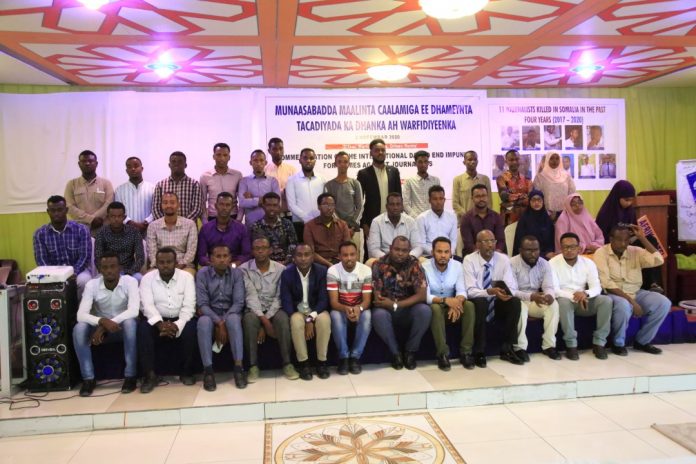
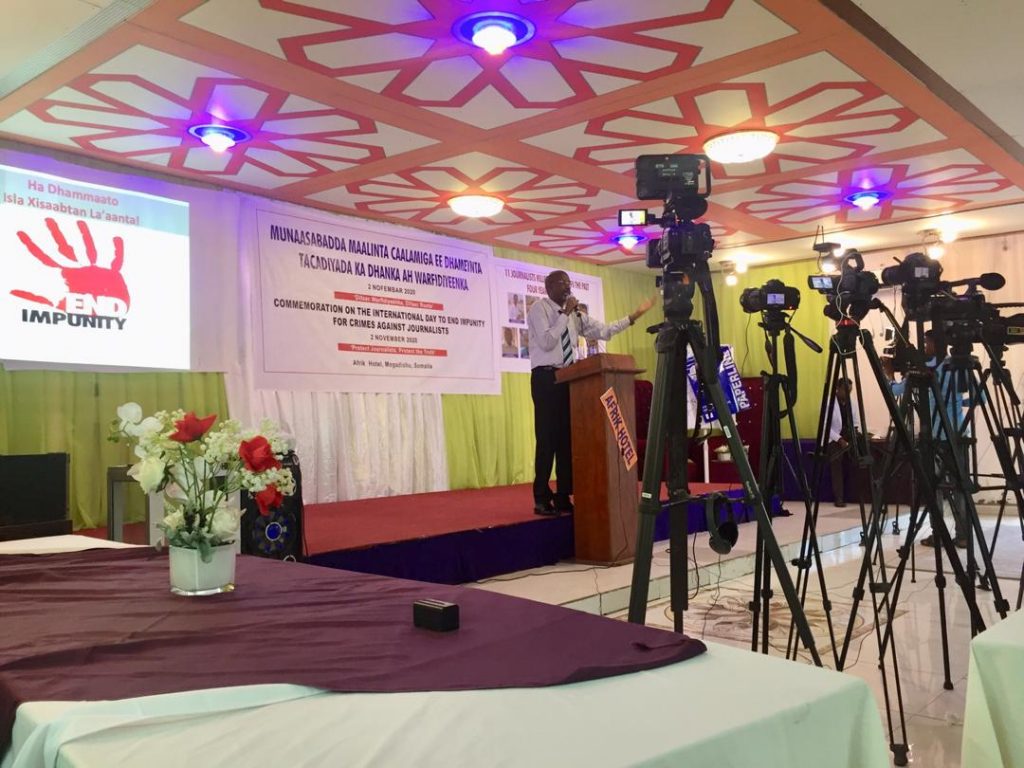
Journalists gather for the commemoration of IDEI on 2 Npovember 2020 in Mogadishu
Journalists and civil society members gather for the commemoration of IDEI on 2 November 2020 in Mogadishu. | PHOTO/SJS.

MOGADISHU, Somalia 2 November 2020 – In a joint commemoration held in Mogadishu on the International Day to End Impunity for the Crimes Against Journalists on 2nd November, Somali Journalists Syndicate (SJS), Somali Media Association (SOMA) and Media Women Network (MWN) called for an urgent action to end the culture of impunity for the crimes against the journalists in Somalia.

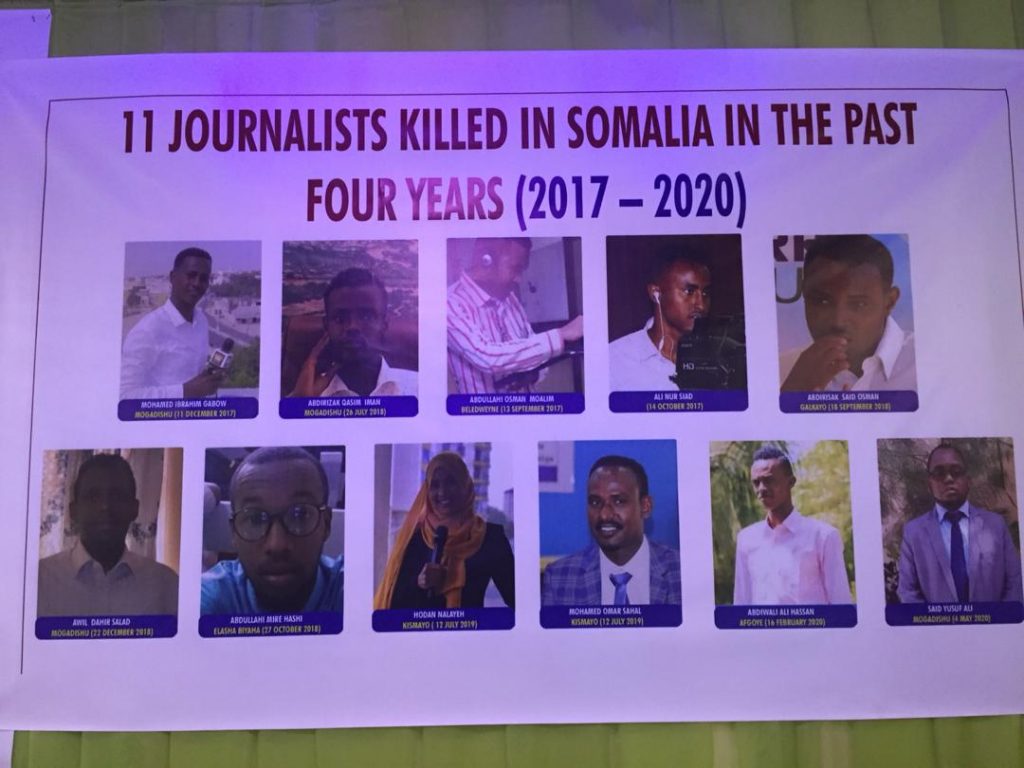
Eleven journalists were killed in the country in the past four years: 3 in 2017; 4 in 2018; 2 in 2019 and 2 in 2020, making the country to remain as one of the most dangerous places for journalists across the globe. For the sixth year in a row, the country has maintained the ignominious world title for impunity towards killed journalists.  Unfortunately authorities in Somalia are reluctant to carry out credible, proper and independent thorough investigations into the cases of killings or attacks on journalists and media outlets.

The total impunity enjoyed by the killers of the journalists allows them to attack scribes for the slightest infractions as journalists now work warily, cognizant of the risks involved –unaware what report may trigger peril and self-censor as a means of survival. Corruption also remains as part of the problem.

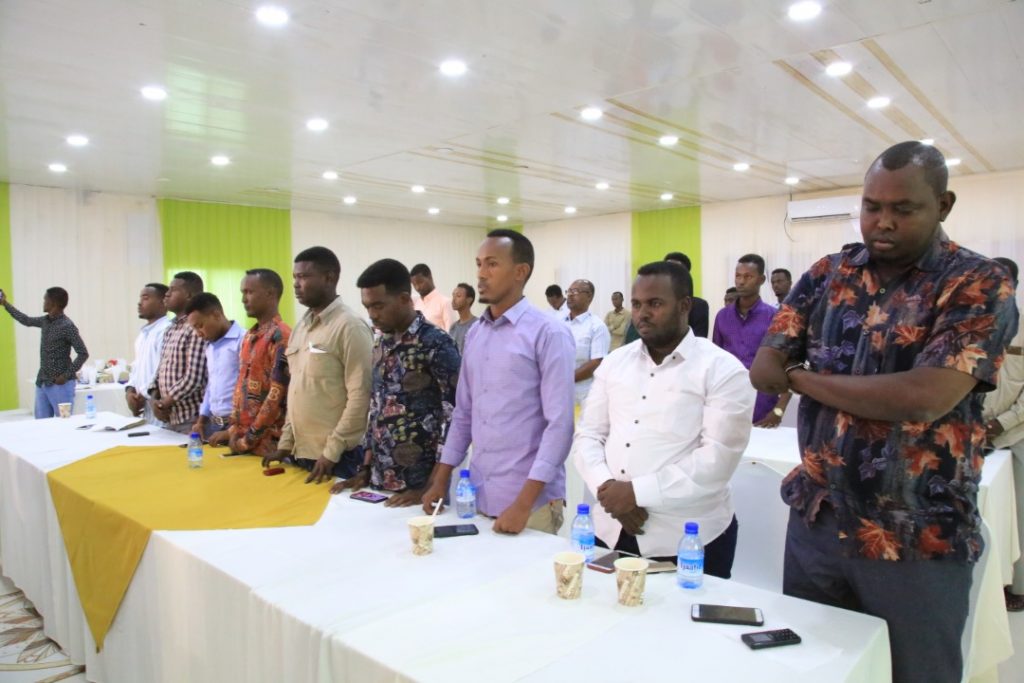
Journalists observe a minute of silence and prayer for the slain colleagues in Somalia during the commemoration of International  Day to End Impunity for Crimes  Against Journalists held in Mogadishu, 2 November 2020. |  PHOTO/SJS.
Journalists observe a minute of silence and prayer for the slain colleagues in Somalia during the commemoration of International Day to End Impunity for Crimes Against Journalists held in Mogadishu, 2 November 2020. | PHOTO/SJS.

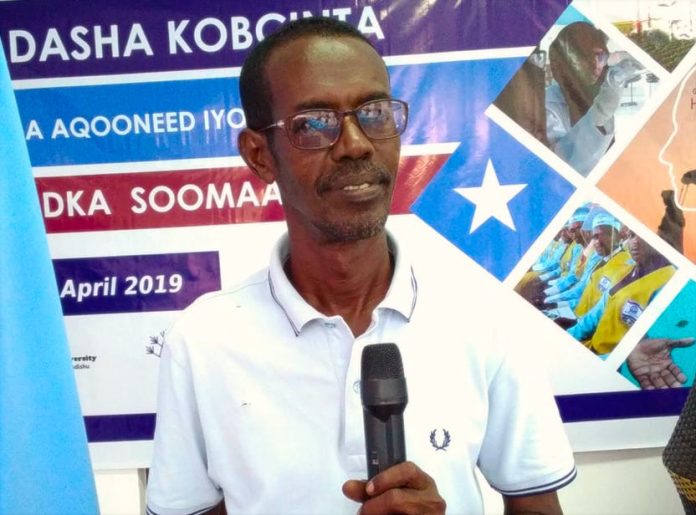
During the Monday’s commemoration, Abdalle Ahmed Mumin, the Secretary General of Somali Journalists Syndicate (SJS) expressed concern about the unprecedented rise of level of assaults and targeted incidents of attacks on journalists in the country in the past few years.

“Apart from the killings, there were also attempted killings, physical assaults that resulted injuries on journalists, death threats and obstruction of access to information,” Mr.  Mumin said.

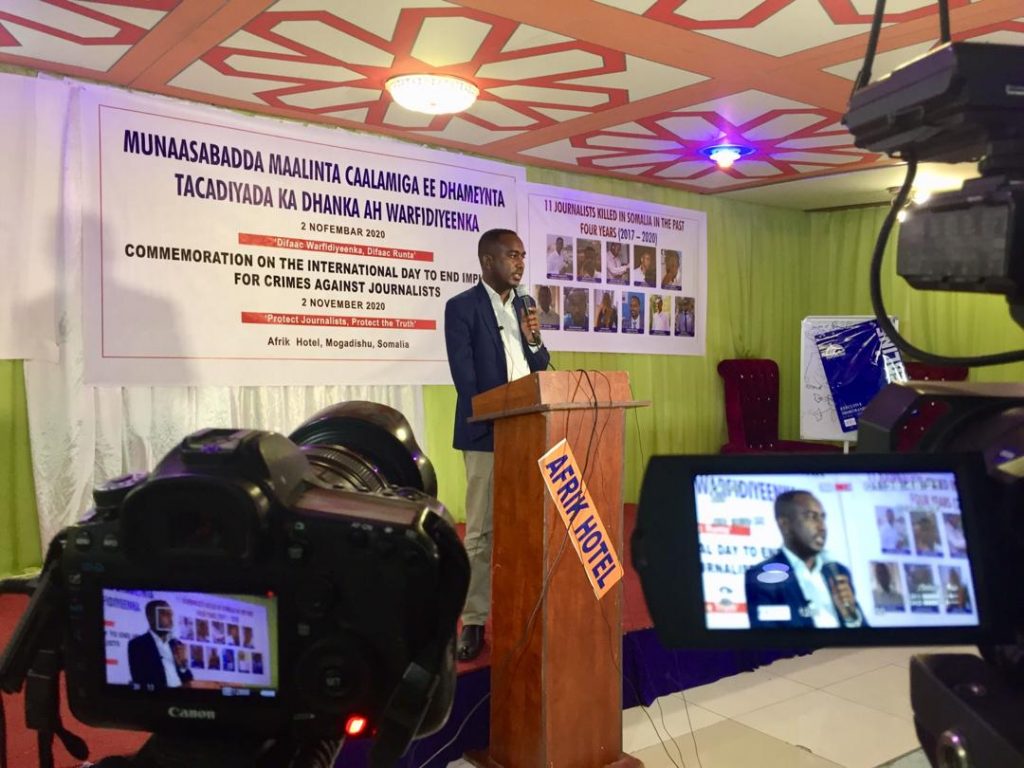
Abdalle Ahmed  Mumin, the secretary general of Somali Journalists Syndicate (SJS) makes a presentation on the cases of 11 journalists killed 2017-2020 during the commemoration of IDEI on 2 November 2020, Mogadishu. | PHOTO/SJS.
Abdalle Ahmed Mumin, the secretary general of Somali Journalists Syndicate (SJS) makes a presentation on the cases of 11 journalists killed 2017-2020 during the commemoration of IDEI on 2 November 2020, Mogadishu. | PHOTO/SJS.

“We condemn all the killings against the journalists in the country as we call for authorities to open proper investigations. This should include investigating security officials, regardless of rank, complicit in abuses against journalists or who fail to adequately investigate alleged harassment, threats or violence against journalists,” Mr  Mumin added.

Mohamed Abduwahab, the secretary general of Somali Media Association noted the need for ensuring safety for the journalists ahead of the upcoming general elections.

“Safety of the journalists should be at paramount importance ahead of the elections. Somali journalists have always seen a cycle of violence during the transition time and this is not an exceptional,” Mr. Abduwahab said.

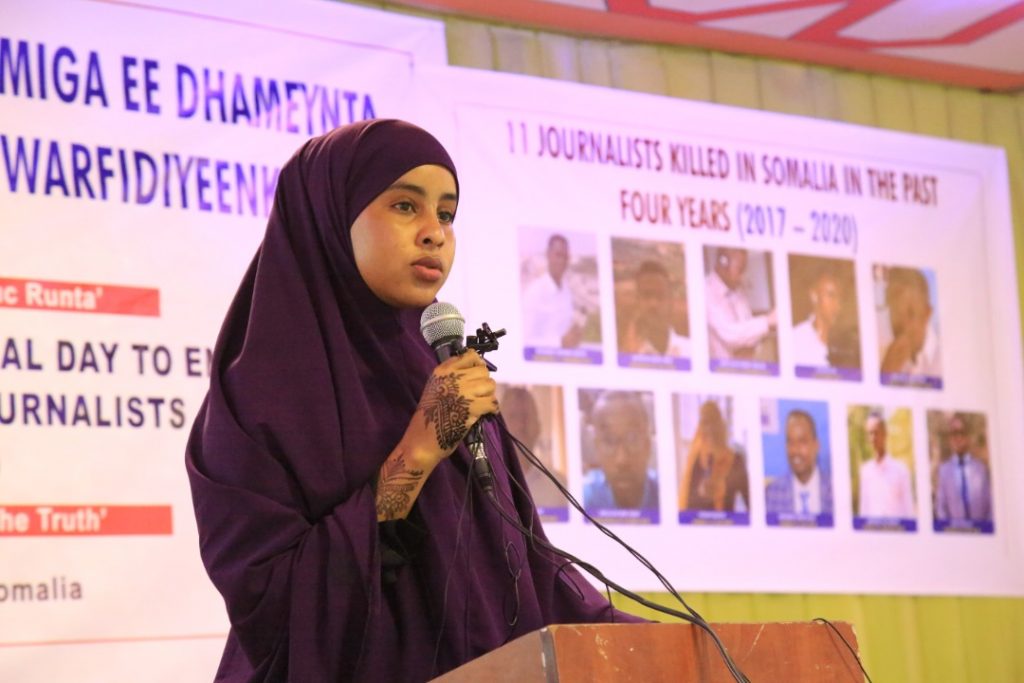
Shamis Abdirahman, the Deputy Chair of Media Women Network speaks during the commemoration of IDEI held in  Mogadishu, 2 November 2020. | PHOTO/SJS.
Shamis Abdirahman, the Deputy Chair of Media Women Network speaks during the commemoration of IDEI held in Mogadishu, 2 November 2020. | PHOTO/SJS.

Shamis Abdirahman, the deputy chair of Media Women Network expressed concern about the impact the insecurity have had on the journalists including that some journalists resorted to self-censorship.

 “Throughout the country, journalists are reluctant to report on certain topics such violence against women and other human rights abuses, without fear of reprisals. This is the negative impact we have seen from the insecurity that journalists are dealing with,” Ms. Said.

On his part, Prof. Hassan Sheikh Nur, a senior Somali National University Lecturer noted the need for a wider initiative to safeguard journalists. He suggested the local communities to stand in solidarity with journalists’ organisations to protect the endangered journalists in certain locations.

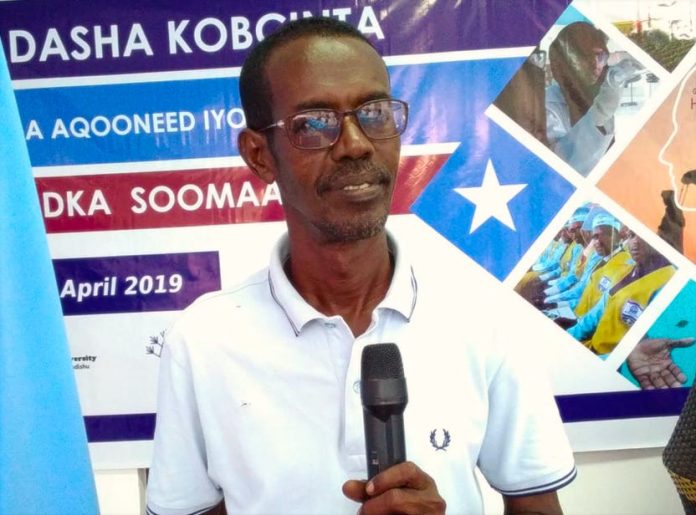
Prof.  Hassan Sheikh Nur, a senior Somali National University Lecturer speaks during the commemoration of IDEI in Mogadishu, 2 November 2020. | PHOTO/SJS.
Prof. Hassan Sheikh Nur, a senior Somali National University Lecturer speaks during the commemoration of IDEI in Mogadishu, 2 November 2020. | PHOTO/SJS.

“I don’t think we have to wait for anybody else. Local communities and journalists’ associations must work together to protect the journalists who are in danger,” Prof Nur said. 

On Monday, journalists, representatives from the media associations and members of the civil society observed a minute of silence and prayer for the slain journalists who were murdered in the line of duty before making a joint recommendations to the Somali Federal Government and the International Community.

A banner with the names and photos of 11 killed journalists displayed during the commemoration of IDEI on 2 November, 2020. | PHOTO/SJS.

Somali Government and its Member States should:

  • Carry out credible and independent investigation into all cases of journalists killed
  •  Publicly condemn physical attacks, killings, threats, harassment, obstruction, intimidation and arbitrary arrests of journalists and other media workers;
  • Ensure that the proposed new prosecutor on crimes against journalists promptly and impartially investigates credible allegations of harassment, threats or violence against journalists and media outlets;
  • This should include investigating security officials, regardless of rank, complicit in abuses against journalists or who fail to adequately investigate alleged harassment, threats or violence against journalists;
  • Direct government officials and security forces to allow journalists and media workers access to government information including by not putting impediments and restrictions on accessing government buildings and interviewing public officials;
  • Train the police and other security officials on human rights including on the right to freedom of expression and media freedom;

The International Community should:

  • Pressure the Federal Government and its Member States to respect, protect, promote and fulfil media freedom and the rights of journalists;
  • Provide support to the efforts by the Somali media associations and the journalists including initiatives to ensure safety and protection for the journalists;
  • Support initiatives by the Somalia government to reform laws and regulatory institutions to bring them into compliance with Somalia’s international human rights obligations; provide technical support and assistance to such initiatives;
  • Continue supporting actions that promote the safety of journalists in Somalia and put pressure on authorities to address the issue of impunity for abuses and attacks against journalists;
  • Publicly speak out about the importance of human rights including the right to freedom of expression and media freedom for Somalia’s peace and state building processes;

Radio Kulmiye journalist held incommunicado for five days freed

0
Prominent Radio Kulmiye journalist, Abdullahi Kulmiye Addow has been detained after armed NISA officers raided his home in Mogadishu on Saturday 17 October, 2020.
Prominent Radio Kulmiye journalist, Abdullahi Kulmiye Addow has been detained after armed NISA officers raided his home in Mogadishu on Saturday 17 October, 2020. | PHOTO/SJS/COURTESY.

MOGADISHU, Somalia 22 October, 2020 – Somali Journalists Syndicate (SJS) and Somali Media Association (SOMA) jointly welcome the release of Radio Kulmiye journalist, Abdullahi Kulmiye Addow who was arbitrary detained and held incommunicado since Saturday night 17 October 2020, by the National Intelligence and Security Agency (NISA) in Mogadishu over an interview deemed critical to the government.

The journalist was released on midday Thursday 22 October on a condition that his radio withdraws the interview with a local businessman who allegedly criticized Somali government and supported the armed group al-Shabaab.   To comply with NISA’s demand, the radio management subsequently canceled the interview, which was scheduled to be aired on Thursday 22 October, according to Radio Kulmiye director, Burhan Dini Farah.

After his freedom, journalist Addow, who complained from extreme fatigue due to the lengthy detention and sleepless nights, has confirmed to SJS and SOMA that he was held incommunicado since Saturday midnight at the notorious Godka Jila’ow prison which is a detention centre actively used by NISA.   In an interview with Radio Kulmiye later on Thursday, Addow also described how he was arrested on Saturday when armed NISA officers accompanied by military officers raided his house.

“It was around midnight when NISA officers, some of them plain-clothed and armed with pistols broke into my home. Also military officers attached to the Office of Somali Prime Minister Mohamed Hussein Roble accompanied them,” Abdullahi Kulmiye Addow said “They told me to follow them because I was scared for the safety of my family who were at the home at that time. They took me to the jail where I was held.”

SJS and SOMA are relieved by the freedom of journalist Abdullahi Kulmiye Addow, however, we are concerned by the level of intimidation and harassment subjected to journalist Addow, his family and the entire journalists and staff of Radio Kulmiye during the period of his detention.

The ban of the interview by Radio Kulmiye is a spiteful act of censorship and a blatant attempt by the Somali federal authorities to stifle freedom of expression ahead of the national elections later this year and early next year.

“We welcome the freedom of our colleague Abdullahi Kulmiye Addow as we condemn the raid on his home on Saturday and the intimidations that followed,” Abdalle Ahmed Mumin, the Secretary General of Somali Journalists Syndicate (SJS) said “Somali federal authorities should stop using NISA and other security forces to attack and harass journalists and media houses aiming to silence the critical voices.”

“SJS and SOMA jointly call for an investigation into the officers who raided journalist Abdullahi Kulmiye Addow’s house on Saturday, including those allegedly from the Office of Somali Prime Minister,” Mohamed Abduwahab Abdullahi, the Secretary General of Somali Media Association (SOMA) said “We are also concerned by the increased violence on journalists and the independent media in the country recently.”

Tanzania: Systematic restrictions on fundamental freedoms in the run-up to national elections

0
Civil society letter endorsed by over 65 organisations to President of Tanzania ahead of 28 October National Elections

To: President John Magufuli

Excellency, 

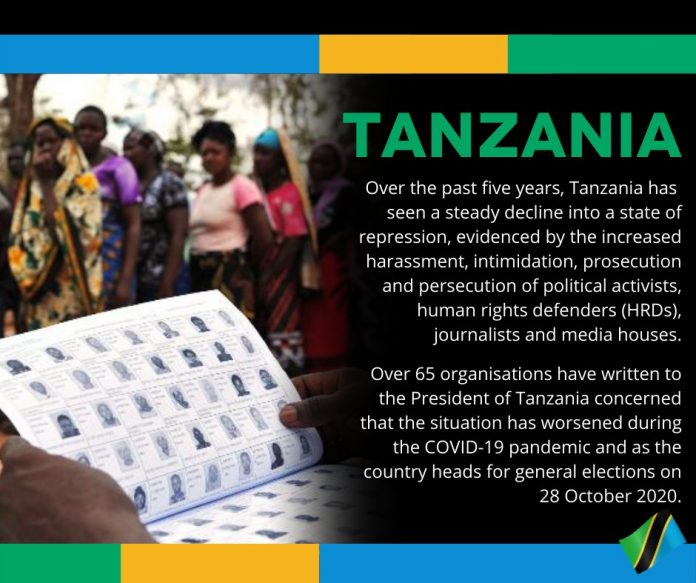
We, the undersigned civil society organizations, are deeply concerned about the continued deterioration of democracy, human rights and rule of law in the United Republic of Tanzania. In the past five years, we have documented the steady decline of the country into a  state of repression, evidenced by the increased harassment, intimidation, prosecution, and persecution of political activists, human rights defenders (HRDs), journalists and media houses; the enactment of restrictive laws; and disregard for rule of law, constitutionalism, as well as regional and international human rights standards. We are deeply concerned that the situation has worsened during the COVID-19 pandemic and as the country heads for general elections on 28 October 2020.[1]

Tanzania as a party to several regional and international treaties, including the International Covenant on Civil and Political Rights and the African Charter on Human and Peoples’ Rights, has a legal obligation to respect and protect fundamental rights, particularly the right to – freedom of expression and the media, peacefully assemble, form and join associations, and to participate in public affairs, which are fundamental rights for free and fair elections in a democratic society. As a member of the African Union (AU) and the Southern African Development Community (SADC), Tanzania has committed to uphold and promote democratic principles, popular participation, and good governance.

Leading up to the elections in Tanzania, we have unfortunately documented an unfavourable environment for public participation and free engagement in the political process. The role of the media in providing information and access to varying viewpoints in a true democracy is indispensable. Media houses must be allowed to provide these services without undue restrictions, yet in recent times, several independent media houses have been suspended. These have included the seven-day suspensions of The Citizen newspaper in February 2019,[2]Clouds TV and Clouds FM in August 2020, and the six-month suspension of Kwanza online TV in September 2019[3] and again in July 2020 for 11 months;[4] the online publication ban against Mwananchi news in April 2020;[5]the revocation, effective June 24, 2020, of the license of the Tanzania Daima newspaper;[6] and the fines against online stations, Watetezi TV and Ayo TV in September 2019.[7]We note, with great disappointment, that the government is yet to comply with a ruling by the East African Court of Justice requiring the amendment of the Media Services Act to address the unjustified restrictions on freedom of expression.[8]

We are further concerned about the restrictions on individuals peacefully expressing their opinions, including criticising public officials.[9] The latter are required to tolerate a greater amount of criticism than others – a necessary requirement for transparency and accountability. Tanzania’s criminal justice system has however been misused to target those who criticize the government. Tito Magoti and IT expert Theodory Giyani were arrested in December 2019 and questioned over their social media use and association with certain government critics.[10]The duo were subsequently charged with economic crimes, including “money laundering” which is a non-bailable offence. Despite their case being postponed more than 20 times since December 2019, and no evidence being presented against them, they remain in pre-trial detention.[11] Investigative journalist Erick Kabendera was similarly arrested and charged with “money laundering” where he was held in pre-trial detention for seven months with his case postponed over ten times.[12] Several United Nations (UN) mandate holders have raised concern about the misuse of the country’s anti-money laundering laws that “allow the Government to hold its critics in detention without trial and for an indefinite period.”[13]

Most recently, a prominent human rights lawyer and vocal critic of the government, Fatma Karume was disbarred from practising law in Tanzania following submissions she made in a constitutional case challenging the appointment of the Attorney General.[14] Other lawyers are also facing disciplinary proceedings for publicly raising issues on judicial independence and rule of law.  Opposition leader, Zitto Kabwe was arrested and prosecuted for statements made calling for accountability for extrajudicial killings by State security agents.[15] The above cases are clear evidence of intolerance for alternative views and public debate.

In addition, authorities should ensure respect for the right of individuals to freely form associations and for those associations to participate in public affairs, without unwarranted interference. We note the increasing misuse of laws to restrict and suspend the activities of civil society organisations.[16] On August 12, Tanzania Human Rights Defenders Coalition (THRDC) was notified that its bank accounts had been frozen pending police investigations. THRDC’s coordinator was then summoned by the police to explain an alleged failure to submit to the State Treasury its contractual agreements with donors.[17]  Prior to this, in June 2020, the authorities disrupted the activities of THRDC for allegedly contravening “laws of the land.”[18] Several other non-governmental organisations working on human rights issues have been deregistered or are facing harassment for issuing public statements critical of the government. Ahead of the elections some civil society organisations have reported being informally told by authorities to cease activities. As a result of the repressive environment, civil society organisations have been forced to self-censor activities. 

We also note the enactment of further restrictive laws.[19] For example, the Written Laws Miscellaneous Amendments Act (The Amendment Act)[20] which has introduced amendments to 13 laws.[21] The Amendment Act requires anyone making a claim for violation of rights to have been personally affected.[22] This limits the ability of civil society organisations to carry out legal aid and law-based activities where they are not personally harmed. It violates Article 26(2) of the country’s Constitution, which provides for the right of every person “to take legal action to ensure the protection of this Constitution and the laws of the land.” Furthermore, it is an internationally recognized best practice that all persons, whether individually or in association with others, have the right to seek an effective remedy before a judicial body or other authority in response to a violation of human rights.[23] The Amendment Act further provides that lawsuits against the President, Vice-President, Prime Minister, Speaker, Deputy Speaker, or Chief Justice cannot be brought against them directly but must be brought against the Attorney General.[24] This provision undermines government accountability for human rights violations. We remind the authorities that international bodies have raised concerns about Tanzania’s repressive laws.[25]

We are especially concerned over the continued cases of verbal threats and physical attacks against members of opposition political parties.[26] We note with concern that to date, no one has been held accountable for the 2017 attack against the CHADEMA party leader, Tundu Lissu, who is a presidential candidate in the upcoming elections. Most recently, opposition leader Freeman Mbowe was brutally attacked and his assailants are still at large. Failure to thoroughly and impartially investigate such cases breeds a culture of violence and impunity, which in turn threatens the peace and security of the country. The government must take steps to bring perpetrators of such violence to account and to guarantee the safety of all other opposition party members and supporters.

Earlier, in November 2019, the African Commission on Human and Peoples’ Rights (ACHPR) issued a press statement on the “deteriorating human rights situation in Tanzania.”[27] The Commission specifically voiced concern over “the unprecedented number of journalists and opposition politicians jailed for their activities.” The ongoing crackdown on civic space in Tanzania also led the UN High Commissioner for Human Rights, Michelle Bachelet, to issue a strong warning ahead of the 28 October 2020 General Elections. At the opening of the UN Human Rights Council’s 45th session, she “[drew] the Council’s attention to increasing repression of the democratic and civic space, in what is becoming a deeply deteriorated environment for human rights” and stressed that “[with] elections approaching later this month, we are receiving increasing reports of arbitrary arrests and detention of civil society actors, activists, journalists and members of opposition parties.” She added: “Further erosion of human rights could risk grave consequences, and I encourage immediate and sustained preventive action.”[28]

While we acknowledge measures taken by your government to halt the spread of the COVID-19 virus and protect the citizens of Tanzania, we are deeply concerned that the pandemic has been used to unduly restrict fundamental freedoms. Examples are the arrest and sentencing of two Kenyan journalists for interviewing members of the public in Tanzania on the status of the pandemic in the country[29] as well as, the suspension of  Kwanza Online TV for reposting an alert by the U.S. embassy in Tanzania regarding the pandemic in the country.[30]  The rights to peacefully express one’s opinion, receive information, peaceful assembly and association, and to participate in public affairs are not only essential in the context of the upcoming elections, but also in relation to the current COVID-19 pandemic. Freedom of expression in particular, ensures “the communication of information to the public, enabling individuals to … develop opinions about the public health threat so that they can take appropriate steps to protect themselves and their communities.”[31]  The UN has repeatedly emphasized that Government responses to COVID-19 must not be used as a pretext to suppress individual human rights or to repress the free flow of information.[32] 

The need for Tanzania to uphold human rights, democracy and the rule of law is now more than ever important as a matter of national security, following recent reports of insurgent attacks along Tanzania’s border with Mozambique.[33] Studies have shown that experiences of injustice, marginalization and a breakdown in rule of law, are root causes of disaffection and violence. A peaceful and prosperous nation requires good governance and respect for rule of law, with a society that protects fundamental freedoms and ensures justice for all.

As civil society organisations deeply concerned about constitutionalism, justice, and democracy in the United Republic of Tanzania, we strongly urge your Excellency to adhere to your undertaking to ensure a free and fair election in Tanzania. The government has an obligation to create an enabling environment for everyone, including political opposition, non-governmental organisations, journalists, and other online users, HRDs, and other real or perceived government opponents to exercise their human rights without fear of reprisals. As such, we call on the relevant authorities to immediately drop criminal charges and release defenders such as Tito Magoti and Theodory Giyani and any others being prosecuted for peacefully exercising their rights. Suspensions and the freezing of assets of non-governmental organisations such as THRDC, independent media houses such as Kwanza Online TV, and members of the legal profession- particularly Fatma Karume, must be reversed.  Opposition parties must be allowed to freely and peacefully campaign and engage with their supporters without undue restrictions such as arbitrary arrests, physical attacks, forceful dispersal and intimidation of supporters, and harassment by security forces. The legitimacy of Tanzania’s elections is at stake.

We call on Tanzania to heed the messages delivered by national, African, and international actors and to change course before the country enters a full-fledged human rights crisis, with potentially grave domestic and regional consequences.

Signed:

  1. Access Now, Global
  2. Acción Solidaria on HIV/aids, Venezuela
  3. Africa Freedom of Information Centre 
  4. Africa Judges and Jurists Forum
  5. AfroLeadership
  6. ARTICLE 19, Global
  7. Asia Dalit Rights Forum (ADRF), New Delhi and Kathmandu
  8. Association for Human Rights in Ethiopia (AHRE)
  9. Association of Freelance Journalists
  10. BudgIT Foundation, Nigeria
  11. CEALDES, Colombia
  12. Center for Civil Liberties, Ukraine
  13. Centre for Human Rights & Development (CHRD), Mongolia
  14. Centre for Law and Democracy, Canada
  15. Center for National and International Studies, Azerbaijan
  16. Child Watch, Tanzania
  17. CIVICUS, Global
  18. Civic Initiatives, Serbia
  19. CIVILIS Human Rights, Venezuela
  20. Collaboration on International ICT Policy for East and Southern Africa (CIPESA)
  21. Committee to Protect Journalists (CPJ)
  22. Community Empowerment for Progress Organization (CEPO), South Sudan
  23. Commonwealth Human Rights Initiative (CHRI)
  24. Corporación Comuna Nueva, Santiago de Chile
  25. DefendDefenders (East and Horn of Africa Human Rights Defenders Project)
  26. Democracy Monitor PU, Azerbaijan
  27. Eastern Africa Journalists Network (EAJN)
  28. Ethiopian Human Rights Council (EHRCO)
  29. Ethiopian Human Rights Defenders Coalition (EHRDC)
  30. Espacio Público, Venezuela
  31. Front Line Defenders, Global
  32. Gestos (HIV and AIDS, communication, gender), Brazil
  33. Greenpeace Africa
  34. Groupe d’Action pour le Progrès et la Paix (GAPP-Afrique), Canada
  35. Groupe d’Action pour le Progrès et la Paix (GAPP-BENIN)
  36. Groupe d’Action pour le Progrès et la Paix (GAPP Mali)
  37. HAKI Africa, Kenya
  38. Human Rights Concern – Eritrea (HRCE)
  39. Human Rights Defenders Network, Sierra Leone
  40. Humanium, Switzerland
  41. HuMENA for Human Rights and Civic Engagement (HuMENA Regional)
  42. International Partnership for Human Rights (IPHR) – Belgium
  43. Jade Propuestas Sociales y Alternativas al Desarrollo, A.C. (JADESOCIALES)- México
  44. Ligue Burundaise des droits de l’homme Iteka-Burundi
  45. Maison de la Société Civile (MdSC), Bénin
  46. MARUAH, Singapore
  47. Media Rights Agenda (MRA), Nigeria
  48. Nigeria Network of NGOs, Nigeria 
  49. Nouvelle Dynamique de la Société Civile de la RD Congo (NDSCI)
  50. Odhikar, Bangladesh
  51. ONG Convergence des Actions Solidaires et les Objectifs de Développement Durable (CAS-ODD ONG) – Bénin
  52. ONG Nouvelle Vision (NOVI), Bénin
  53. Open School of Sustainable Development (Openshkola), Russia
  54. Open Society Initiative for Southern Africa (OSISA)
  55. Partnership for Peace and Development, Sierra Leone
  56. RESOSIDE, Burkina Faso
  57. Robert F. Kennedy Human Rights, Global
  58. Sisters of Charity Federation, United States
  59. Somali Journalists Syndicate (SJS), Somalia
  60. Southern Africa Human Rights Defenders Network (SAHRDN)
  61. Sudanese Development Initiative (SUDIA), Sudan
  62. The Human Rights Centre Uganda (HRCU), Uganda
  63. Tournons La Page (TLP)
  64. Water, Sanitation and Hygiene Network, Sierra Leone
  65. Women in Democracy And Governance, Kenya (WIDAG)
  66. Zambia Council for Social Development, Zambia

[1] United Nations, Office of the High Commissioner, UN Experts call on Tanzania to end the crackdown on civic space, July 22, 2020, available at https://www.ohchr.org/en/NewsEvents/Pages/DisplayNews.aspx?NewsID=26117&LangID=E.

[2] Committee to Protect Journalists, Tanzania imposes 7-day publication ban on The Citizen, March 01, 2019, available at https://cpj.org/2019/03/tanzania-citizen-7-day-publication-ban/

[3] Committee to Protect Journalists, Tanzanian authorities ban online TV station, fine 2 others, January 8, 2020, available at https://cpj.org/2020/01/tanzanian-authorities-ban-online-tv-station-fine-2/

[4] Committee to Protect Journalists, Tanzania bans Kwanza Online TV for 11 months citing ‘misleading’ Instagram post on COVID-19, July 09, 2020, available at https://cpj.org/2020/07/tanzania-bans-kwanza-online-tv-for-11-months-citing-misleading-instagram-post-on-covid-19/

[5] Committee to Protect Journalists, Tanzanian newspaper banned from publishing online for 6 months over COVID-19 report, May 11, 2020, available at https://cpj.org/2020/01/tanzanian-authorities-ban-online-tv-station-fine-2/

[6] Committee to Protect Journalist, Tanzanian government revokes license of Tanzania Daima newspaper, June 26, 2020, available at https://cpj.org/2020/06/tanzanian-government-revokes-license-of-tanzania-daima-newspaper/

[7] Committee to Protect Journalists, Tanzanian authorities ban online TV station, fine 2 others, January 8, 2020 available at https://cpj.org/2020/01/tanzanian-authorities-ban-online-tv-station-fine-2/

[8]Committee to Protect Journalists, East Africa court rules that Tanzania’s Media Services Act violates press freedom, March 28, 2019, available at https://www.mediadefence.org/news/important-media-freedom-judgment-east-african-court-justice

[9] We refer to cases such as the arrest of prominent comedian, Idris Sultan, in May 2020 (https://thrdc.or.tz/tanzanian-comedian-and-actor-mr-idris-sultan-charged-for-failure-to-register-a-sim-card/), and the disbarment from practicing law of prominent lawyer and human rights advocate, Fatma Karume (https://www.icj.org/tanzania-icj-calls-for-reinstatement-of-lawyer-fatma-karumes-right-to-practice-law/). 

[10] Committee to protect journalists, Mwanachi, The Citizen, last seen in Tanzania, November 21, 2017, available at https://cpj.org/data/people/azory-gwanda/.

[11] American Bar Association, Center for Human Rights, Tanzania: Preliminary Analysis of the criminal case against Tito Magoti and Theodory Giyani, July 28, 2020, available at https://www.americanbar.org/groups/human_rights/reports/tanzania–preliminary-analysis-of-the-criminal-case-against-tito/.

[12] Committee to Protect Journalists, Tanzanian journalist Erick Kabendera freed but faces hefty fines, February 24, 2020, available at https://cpj.org/2020/02/tanzanian-freelancer-erick-kabendera-freed-but-fac/

[13] Mandates of the Special Rapporteur on the situation of human rights defenders; the Working Group on Arbitrary Detention; the Working Group on Enforced or Involuntary Disappearances; the Special Rapporteur on the promotion and protection of the right to freedom of opinion and expression; and the Special Rapporteur on the rights to freedom of peaceful assembly and of association, Letter to President of Tanzania, Reference AL TZA 1/2020, January 31, 2020, available at https://spcommreports.ohchr.org/TMResultsBase/DownLoadPublicCommunicationFile?gId=25049.

[14] International Commission of Jurists, Tanzania: ICJ Calls for the reinstatement of lawyer Fatma Karume’s right to practice law, October 8, 2020, available at https://www.icj.org/tanzania-icj-calls-for-reinstatement-of-lawyer-fatma-karumes-right-to-practice-law/

[15]The Citizen, Zitto Kabwe sentenced to serve one year ban not writing seditious statements, May 29, 2020, available at https://www.thecitizen.co.tz/news/Zitto-Kabwe-found-guilty-of-sedition/1840340-5567040-m7pifrz/index.htm

[16] The cancellation of a training organised by Tanzania Human Rights Defenders Coalition (THRDC), the subsequent arrest of THRDC’s Director, Onesmo Olengurumwa, and suspension of the activities of the organisation, as well as freezing of their accounts, exemplifies the misuse of these laws against civil society (See: https://www.aa.com.tr/en/africa/tanzania-human-rights-group-suspends-operations/1945400)

[17] DefendDefenders, Tanzania: Respect the right to freedom of association, August 24, 2020, available at https://defenddefenders.org/tanzania-respect-the-right-to-freedom-of-association/.

[18] Two employees of one of THRDC were arrested in Dar es Salaam and thereafter authorities proceed to arbitrarily cancel the hosting of a three-day security training for 30 human rights defenders. The police claimed that the training was in contravention of the “laws of the land” but did not give a specific provision

[19] These include the Electronic and Postal Communications (Online Content) Regulations; Media Services Act; Cybercrimes Act; and Political Parties Amendment Act.

[20] Written Laws (Miscellaneous Amendments Act (No. 3) of 2020)

[21] Southern Africa Litigation Center, Joint letter, The Written Laws Miscellaneous Amendments Act no.3 ( 2020), available at https://www.southernafricalitigationcentre.org/wp-content/uploads/2020/08/Honourable-Minister-of-Justice-for-the-Republic-of-Tanzania.pdf-August-2020.pdf

[22] Section 7(b) of the Written Laws Amendments Act

[23] The African Commission’s Principles and Guidelines on the Right to a Fair Trial and Legal Assistance in Africa provide that States must ensure through the adoption of national legislation that any individual, group of individuals or nongovernmental organization is entitled to bring a human rights claim before a judicial body for determination because such claims are matters of public concern.

[24] Amendments to Chapter 310 of the Law Reform (Fatal accidents and miscellaneous provisions) Act and to the Chapter 3 of the Basic Rights and Duties Enforcement Act

[25]   See for example communication of the Mandates of the Special Rapporteur on the promotion and protection of the right to freedom of opinion and expression; and the Special Rapporteur on the rights to freedom of peaceful assembly and of association to the government of the United Republic of Tanzania, AL TZA 3/2020, 17 July 2020, https://spcommreports.ohchr.org/TMResultsBase/DownLoadPublicCommunicationFile?gId=25442 

[26] These include the verbal abuse and threats of execution against Zitto Kabwe, leader of Alliance for Change and Transparency (ACT) Wazalendo opposition party (see: https://www.bbc.com/news/world-africa-51355148), his conviction for sedition for statements he made at a press conference in relation to alleged extra judicial killings by state security forces (https://www.thecitizen.co.tz/news/Zitto-Kabwe-found-guilty-of-sedition/1840340-5567040-m7pifrz/index.html), and his re-arrested together with several party members while they participated in an internal meeting (https://www.aljazeera.com/news/2020/06/24/tanzanian-opposition-leader-zitto-kabwe-released-on-bail/); as well as the conviction of nine Members of Parliament belonging to the opposition Chama Cha Demokrasia(CHADEMA) party and their sentencing in March 2020 to five months in prison or an alternative fine, for allegedly making seditious statements (https://www.reuters.com/article/us-tanzania-politics/tanzanian-opposition-lawmakers-found-guilty-of-making-seditious-statements-idUSKBN20X2O8); and the attack against the party leader, Freeman Mbowe, by unknown assailants leaving him with a broken leg (https://www.reuters.com/article/us-tanzania-politics/tanzanian-opposition-lawmakers-found-guilty-of-making-seditious-statements-idUSKBN20X2O8).

[27] African Commission on Human and Peoples’ Rights, Press statement of the African Commission on Human and Peoples’ Rights on the deteriorating human rights situation in Tanzania, available at https://www.achpr.org/pressrelease/detail?id=459.

[28] Office of the UN High Commissioner for Human Rights, “In her global human rights update, Bachelet calls for urgent action to heighten resilience and protect people’s rights,” 14 September 2020, https://www.ohchr.org/EN/NewsEvents/Pages/DisplayNews.aspx?NewsID=26226&LangID=E

[29] Tanzania Human Rights Defenders Coalition, Two Kenyan Journalists convicted and fined in Tanzania, repatriated back to Kenya, May 21, 2020, available at https://thrdc.or.tz/blog/.

[30]American Bar Association, Center for Human Rights, Report on the arbitrary suspension of Kwanza Online TV for sharing information related to the COVID-19 pandemic, October 22, 2020. See also Kwanza TV Instagram, available athttps://www.instagram.com/p/CCGT_5ECT_n/?utm_source=ig_web_button_share_sheet

[31] Disease pandemics and the freedom of opinion and expression, A/HRC/44/49, para. 30

[32] The Guardian, Coronavirus pandemic is becoming a human rights crisis, UN warns, 23 April 2020, available at https://www.theguardian.com/world/2020/apr/23/coronavirus-pandemic-is-becoming-a-human-rights-crisis-un-warns. See also UNHRC,, UN Special Rapporteur on freedom of peaceful assembly and of association, States responses to Covid 19 threat should not halt freedoms of assembly and association, April 14, 2020, available at https://www.ohchr.org/EN/NewsEvents/Pages/DisplayNews.aspx?NewsID=25788&LangID=E.

[33] BBC, Tanzania border village attack “leaves 20 dead”, October 16, 2020, available at https://www.bbc.com/news/live/world-africa-47639452?ns_mchannel=social&ns_source=twitter&ns_campaign=bbc_live&ns_linkname=5f896f00c4548e02bf3cb441%26Tanzania%20border%20village%20attack%20%27leaves%2020%20dead%27%262020-10-16T10%3A29%3A29.229Z&ns_fee=0&pinned_post_locator=urn:asset:2f81fc88-030c-49d4-9d25-b8268a2dbf55&pinned_post_asset_id=5f896f00c4548e02bf3cb441&pinned_post_type=share
NISA oo wareysi dartiis u xirtay weriye Cabdullaahi Kulmiye Caddow oo ka tirsan Radio Kulmiye

0
Prominent Radio Kulmiye journalist, Abdullahi Kulmiye Addow has been detained after armed NISA officers raided his home in Mogadishu on Saturday 17 October, 2020. | PHOTO/SJS/COURTESY.

MUQDISHO, Soomaaliya 18 Oktoobar, 2020 – Ururka Suxufiyiinta Soomaaliyeed ee SJS iyo Dalladda Warbaahinta Soomaaliyeed ee SOMA ayaa si adag u cambaareeyay weerarka iyo xarigga magaalada Muqdisho loogu geystay weriyaha caanka ah ee Radio Kulmiye, Cabdullaahi Kulmiye Caddow habeennimadii Sabtida 17 Oktoobar 2020.

Sida ay xaqiijiyeen suxufiyiita ay isla shaqeynayeen weriye Caddow iyo qoyskiisaba, ciidamo aad u hubeysan oo ka tirsan Hay’adda Nabadsugidda iyo Sirdoonka Qaranka (NISA) ayaa weeraray hoyga weriyaha abbaare 11:30 habeennimo ee Sabtidii, iyagoo khalkhal ku abuuray qoyska weriyaha iyagoo kaddibna kexeystay weriyaha. Lama oga halka lagu xiray weriyaha illaa hadda.

Weerarka lagu ekeeyay hoyga weriyaha ayaa yimid saddex maalmood ka bacdi markuu weriye Cabdullaahi Kumiye Caddow wareystay nin ganacsade ah oo lagu eedeeyay inuu taageeray kooxda hubeysan ee al-Shabaab isla markaana cambaareeyay Dowladda Federaalka Soomaaliya, sida ay sheegeen agaasimaha Radio Kulmiye (KNN), Burhaan Diini Faarax iyo tifaftire Cabdiqani Cabdullaahi.

Markii lala xiriiray NISA masoo jawaabin, halka saraakiil ku sugan Taliska Danbi Baarista ee CID-da ay sheegeen inaysan ka warheyn xarigga weriyaha isla markaana aanan lagu xirin xarunta CID-da.

SJS iyo SOMA waxay ka walaacsan yihiin xaaladda badqabka jir ahaaneed iyo maskax ahaaneed ee weriye Cabdullaahi Kulmiye Caddow kaasoo aan la ogeyn halka lagu hayo. Waxaan ku baaqeynaa in si deg deg ah oo shuruud la’aan ah loo siidaayo weriyaha, kuwii ka dambeeyay weerarka gurigiisa lagu qaadeyna la horkeeno sharciga.

“Waa wax laga caroodo inaanu maqalnay weerarka hoyga weriye Cabdullaahi Kumiye Caddow lagu qaaday iyo xarigga loo geystay iyadoo aanan la sheegin halka lagu hayo, iyadoo sababta kaliya ee sidaa loo yeelayna ay tahay inuu soo bandhigay warbixin lid ku ah dowladda. Tani ma ahan wax la aqbali karo. Waxaanu ku baaqeynaa in si deg deg ah oo aanan shuruud lahayn loo siidaayo,” sidaa waxaa yiri Cabdalle Axmed Mumin, Xoghayaha Guud ee SJS.

“Warfidiyeenka iyo xarumaha warbaahinta waa in loo oggolaadaa inay si xor ah uga soo waramaan shacdooyinka xasaasiga ah iyagoo aanan ka cabsaneyn xarig ama handadaad, xitaa hadday yihiin warar aysan jecleysaneynin Dowladda,” ayuu sii raaciyay hadalkiisa Xoghaye Mumin.

“Weerarka lagu qaaday hoyga weriye Cabdullaahi Kulmiye Caddow waa weerar halis ah oo lagu qaaday xorriyadda saxaafadda ee Soomaaliya. Xariggiisuna wuxuu la mid yahay afduub,” sidaasi waxaa yiri Maxamed Cabduwahaab Cabdullaahi, Xoghayaha Guud ee SOMA.

“Waxaan ugu baaqeynaa masuuliyiinta Dowladda inay joojiyaan caga-jugleynta ay ku hayaan warfidiyeenka iyo xarumaha warbaahinta ee loo arko inay soo tabiyaan dhacdooyinka ay dhibsaneyno Dowladda,” ayuu hadalkiisa sii raaciyay Xoghaye Maxamed.

Radio Kulmiye journalist detained in an undisclosed location after interviewing a businessman in Mogadishu

0
Prominent Radio Kulmiye journalist, Abdullahi Kulmiye Addow has been detained after armed NISA officers raided his home in Mogadishu on Saturday 17 October, 2020.
Prominent Radio Kulmiye journalist, Abdullahi Kulmiye Addow has been detained after armed NISA officers raided his home in Mogadishu on Saturday 17 October, 2020. | PHOTO/SJS/COURTESY.

MOGADISHU, Somalia 18 October 2020 – Somali Journalists Syndicate (SJS) and Somali Media Association (SOMA) vehemently condemn the raid on the prominent Radio Kulmiye journalist, Abdullahi Kulmiye Addow’s home and his illegal detention by officers from the National Intelligence and Security Agency (NISA) in Mogadishu on Saturday midnight 17 October, 2020.

According to colleagues and family members, heavily armed NISA officers raided journalist Addow’s house in Mogadishu around 11:30pm local time on Saturday leaving the family terrified and subsequently detained him. He has since been held at undisclosed location.

The raid follows three days after the journalist’s interview with a businessman who allegedly supported the armed group al-Shabaab and criticised the Somali authorities, according to the director of Radio Kulmiye, Burhan Dini Farah and the radio editor Abdiqani Abdullahi.

When contacted, NISA did not respond and the police officials at the Criminal Investigations Department (CID) said they were not aware of the arrest nor was he detained at the CID.

SJS and SOMA are concerned about the physical and mental health conditions of journalist Abdullahi Kulmiye Addow. We call for his immediate and unconditional release and those responsible for the raid on his home should be brought to book.

“It is outrageous to hear that Abdullahi Kulmiye Addow’s house was raided and himself detained in an undisclosed location just for reporting a news story critical to the government. This is unacceptable. We call for his immediate and unconditional release,” Abdalle Ahmed Mumin, the secretary general of Somali Journalists Syndicate (SJS) said “Journalists and their media houses should be allowed to freely report on crucial news stories without fear of arrest or harassment even if they are not favored by the authorities.”

“The raid on Radio Kulmiye journalist, Abdullahi Kulmiye Addow’s house is a serious attack on press freedom in Somalia. His detention in an undisclosed location is also an abduction,” Mohamed Abduwahab Abdullahi, the secretary general of Somali Media Association (SOMA) said “We call authorities to stop harassing journalists and media houses deemed critical to the state.”

Armed Somali police threaten, harass and arbitrary detain journalists in Mogadishu and Baidoa

0
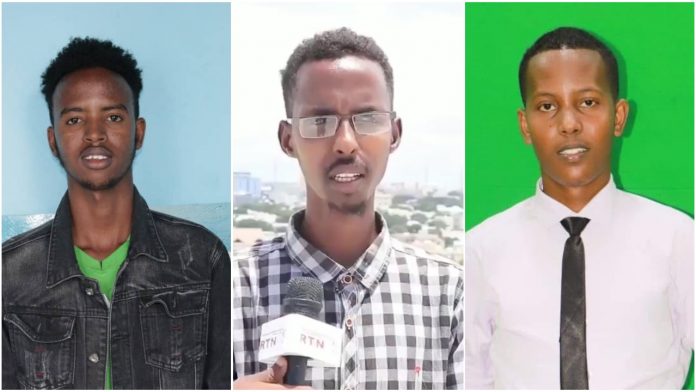
Cameraman Yusuf Mohamed Adan (left); Radio Kulmiye reporter, Farhan Mohamed Hussein (centre) and Radio Kulmiye cameraman, Mowlid Haji Abdi Kheyre (right) were attacked and detained by the police in Baidoa and Mogadishu..
Cameraman Yusuf Mohamed Adan (left); Radio Kulmiye reporter, Farhan Mohamed Hussein (centre) and Radio Kulmiye cameraman, Mowlid Haji Abdi Kheyre (right) were attacked and detained by the police in Baidoa and Mogadishu. | PHOTO/COMBINED/SJS.

MOGADISHU, Somalia 06 October 2020 – Somali Journalists Syndicate (SJS) and Somali Media Association (SOMA) strongly condemn the gun threat, harassment and arbitrary detention by Somali police against journalists on Friday 2 October 2020 in Baidoa and on Monday 5 October 2020 in Mogadishu respectively.

On Friday, South West State police detained freelance cameraman, Yusuf Mohamed Adan, who reports for Five Somali TV and Arlaadi News website, while covering a clan protest in Baidoa, according to Yusuf himself and colleagues.  He was held at the Baidoa police station until Sunday 4 October, when he was freed without charge.

On Monday, Radio Kulmiye reporter, Farhan Mohamed Hussein and his cameraman Mowlid Haji Abdi Kheyre were attacked by a uniformed police officer at Tarabunka junction in Mogadishu’s Hodan district. According to a video evidence and interviews with the pair, the radio journalists were on assignment to gather vox-pops from tuk tuk drivers regarding the re-opening of roads previously blocked by the security forces.  The police officer blocked the journalists from recording videos and threatened to shoot if they do so.  They were held at Hodan police station for several hours. Both were freed without charge.

“The police officer harassed us at gunpoint and even threatened to shoot us if we continue recording videos, forcing us to stop the interview,” said cameraman Mowlid.

SJS and SOMA are extremely concerned by the lack of accountability in the police to ensure credible investigation whenever their officers attack or threaten journalists.  It is also harrowing that journalists came under armed police attack while simply doing their job.

“We are very concerned by these latest string of targeted attacks on journalists in Mogadishu and Baidoa. These incidents follow President Mohamed Abdullahi Farmajo’s public comments on September 26 linking some journalists to al-Shabaab without any evidence,” Abdalle Ahmed Mumin, the secretary general of Somali Journalists Syndicate (SJS) “We jointly call for an immediate investigation into these incidents. In order to end the impunity for crimes against journalists, Somali Federal government and its Member States should be serious and make sure redress for all abuses against journalists, including harassment, threats, attacks, arbitrary detention, and murder.”

“The police officers, who harassed the journalists and threatened, must be held accountable and a thorough and honest investigation be opened,” Mohamed Abdulwahaab, Secretary General of Somali Media Association said, “No police officer should be above the law”

Meanwhile SJS and SOMA welcome the joint letter by Amnesty International, Human Rights Watch and Committee to Protect Journalists (CPJ) on Monday which calls for Somali President to take concrete steps to protect the media ahead of elections by starting with reforming the draconian media law and refraining from making statements that place journalists at risk.

Further, ahead of the elections, we jointly remind Somalia political leaders, the civil society groups and the international partners to take their responsibility to protect human rights including the right to freedom of expression and press freedom before, during and after the election, and therefore ensure that individuals known to have committed serious human rights violations — including violations and rights abuses against journalists— are not allowed to run for elected positions or any other government roles.

On IDUAI, SJS and SOMA bemoan Somali president’s unwarranted verbal attack on journalists

0

MOGADISHU, Somalia, 28 September 2020 – On the International Day for Universal Access to Information (IDUAI), Somali Journalists Syndicate (SJS) and Somali Media Association (SOMA) bemoan and strongly reject President Mohamed Abdullahi Farmaajo’s comments on Saturday night 26 September, when he linked journalists critical to his administration to al-Shabaab and blamed them for lack of knowledge without providing any single evidence.

In addition to the generalized ongoing violence against journalists, authorities in Somalia have often invoked alleged national security concerns and the fight against Al-Shabaab as a basis to attack journalists, shut down media houses, restrict the right to freedom of expression and access to information.

Somali journalists have been working under precarious conditions. About 70 journalists and media professionals were murdered in the line of duty since 1992 and 10 of them were killed since 2017 when President Farmajo took office. Number of journalists fleeing the country, due to safety reasons, also rose up. Journalists not only face endless violations and assassinations but their perpetrators almost always get away with impunity.

 “It is pitiful to see the Head of State- someone supposed to call for the protection of journalists and condemn the violations against the press- publicly linking journalists to terrorists. This is very dangerous and we call for the Somali President Mohamed Abdullahi Farmaajo to retract his comment and condemn all violations against the journalists and the media,” Abdalle Ahmed Mumin, the Secretary General of Somali Journalists Syndicate (SJS) said “Ahead of the elections, Somalia’s international partners should support efforts to improve safety of journalists and encourage the Somali government to stop human rights violations and abuses including attacks on media freedoms and carry out impartial, independent, transparent and effective investigations into all violations and attacks against journalists and other media houses.”

 “We express grave concerns that such comments by the Head of State in this critical time will not only endanger the safety of working journalists and media houses but also amount to a green light to the security forces to carry out further attacks against journalists and media houses with impunity in the pretext of countering al-Shabaab,” Mohamed Abduwahab Abdullahi, the Secretary General of Somali Media Association (SOMA) said.

SJS and SOMA also reject the President’s notion to describe the media law he signed recently as the “first one that gives rights to the journalists”. Contrary to the President’s claim, the Somali Media Law was first signed in January 2016 and the amendment started in March 2017. Further the amended version of the Media Law contains problematic and draconian provisions that threaten media freedom and the safety of the journalists.

Radio journalist detained in Hargeisa, Somali Parliament officials threaten media over controversial sexual bill coverage

0
Freelance radio journalist, Ilyas Abdi Ali is detained in Hargeisa
Police in Hargeisa detain freelance radio journalist, Ilyas Abdi Ali (pictured) on Monday 14 September, 2020 over a facebook post. | PHOTO/Courtesy/Private.

MOGADISHU, Somalia, 15 September 2020 – Somali Journalists Syndicate (SJS) and the Somali Media Association (SOMA) condemn the detention of freelance radio journalist, Ilyas Abdi Ali by the Somaliland police in Hargeisa on Monday 14 September, 2020, meanwhile, we call for officials at Somalia’s Federal Parliament to cease threats and intimidation targeting journalists and media houses who covered the Monday’s heated debate in the Lower House.

On Monday evening 14 September, police in Hargeisa detained journalist Ilyas Abdi Ali who simultaneously freelances for the Mogadishu-based independent Radio Kulmiye and the Nairobi-based humanitarian Radio Ergo. According to colleagues and journalists in Hargeisa, Ilyas was detained over a Facebook post calling for the release of Abdimanan Yusuf, the owner of Astaan TV, a local subscription-based cable TV service provider, who remains detained in Hargeisa since 17 July, 2020.  On Tuesday 15 September, a court in Hargeisa granted the police seven days of remand in custody for journalist Ilyas pending investigation, according to family and colleagues.

“Any form of Attack against  journalists is unacceptable and Somaliland authorities should immediately release journalist Ilyas Abdi Ali,” Mohamed Abdiwahab, Secretary General of Somali Media Association (SOMA) said “Ilyas is a humanitarian journalist and his arrest not only represents a threat to the journalists in Somaliland but also constitutes rights violations.” 

Whereas, SJS and SOMA are concerned by the threats and intimidations levelled at journalists covering the Lower House of the Somali Federal Parliament, following a heated debate on the controversial sexual bill on Monday. We call for the officials at the Speaker’s Office to withdraw their threats of suspension against the media houses who covered the event.

“We are concerned that officials at the Parliament are threatening media houses with suspension for only covering a public debate in the Parliament. This must stop and media houses should be able to continue their coverage of the Parliament without any condition,” Abdalle Ahmed Mumin, the Secretary General of Somali Journalists Syndicate (SJS) said “The Parliament is the core branch, which oversights the country’s democratic institutions, and only through the independent media, will the public know about what legislations are being processed or debated.”

Separately, on Tuesday 8 September, police at Mogadishu’s Aden Abdulle International Airport blocked two journalists from Somali Cable TV, who were on assignment to cover an opposition politician returning to the country. According to the journalists, when they have asked for clarification, the police cited instructions from the Ministry of Information. However the officials at the Ministry of Information denied that they have given such instructions.

Meanwhile, Universal TV reporter, Khadar Rigah has been released on 12 September without charge after spending five days in Las Anod police cell over his coverage of a protest in Las Anod town.

Amid worsening press freedom situation, Puntland and Somaliland carry out multiple journalists’ arrest

0
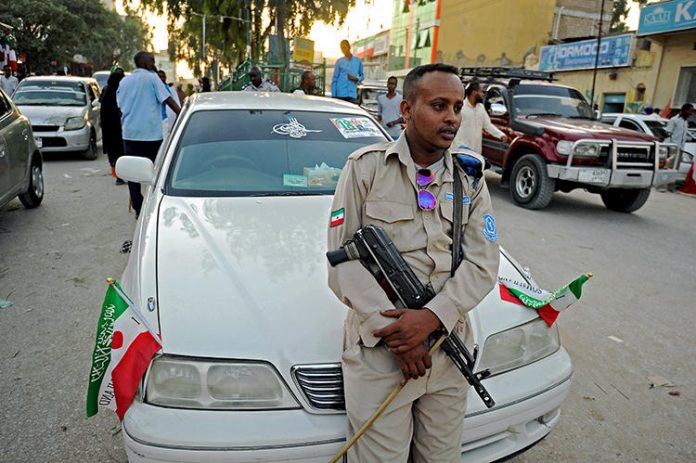
A police officer is seen in Hargeisa, Somaliland, on May 16, 2016. (AFP/Mohamed Abdiwahab)
A policeman stands on a car as he holds a rifle in downtown Hargeisa on May 16, 2016. | PHOTO/ MOHAMED ABDIWAHAB / AFP).

MOGADISHU, Somalia, 09 September 2020 – Somali Journalists Syndicate (SJS) and the Somali Media Association (SOMA) strongly condemn the multiple arrests against journalists and the judicial and police harassment by Puntland authorities in Garowe and Somaliland authorities in Hargeisa, Erigavo and Las Anod towns during the past few weeks amid a worsening press freedom situation.

On Sunday 6 September, Nugal Regional Court judge, Abdinur Jama ordered the arrest of two Radio Daljir journalists, Abdiqani Ahmed Mohamed and Khadar Awl after they visited the court complex in Garowe, the capital of Puntland. The journalists were pursuing a follow-up story of murder and rape case that took place in Garowe months ago.  According to the journalists and colleagues, both were released on Monday 7 September on a condition that they would be summoned back once the prosecutor prepares their charges.

“We condemn the judicial and police harassment and arbitrary arrests against Radio Daljir journalists which goes against both Puntland and Federal Constitution which guarantee the freedom of expression and that of the press,” Mohamed Abdiwahab, Secretary General of SOMA said, “Puntland authorities should stop pressing charges against the duo who only reported on stories that matters on public interest.”

In Las Anod town, Somaliand police on Monday 7 September detained Saab TV reporter, Abdifatah Mohamed Abdi after reporting the destruction of city roads by the recent rains. The Mayor of Las Anod, Mr. Abdiaziz Hassan Tarwale, reportedly ordered the arrest. According to the journalist, he was freed on Tuesday morning 8 September without charge.   However, Las Anod police on Tuesday morning 7 September arrested another journalist, Universal TV reporter, Khadar Rigah a week after his coverage of a protest by the local businesswomen against the recent demolition of business structures and taxes hike by the city administration.  The journalist is still held at the police station.

In Hargeisa, Eryal TV journalist Liban Osman Ali and Wajaale News website reporter, Abdiqadir Habane were freed without charges after spending six and three days respectively in the Criminal Investigations Department (CID), according to Ali and Habane.  Ali was arrested on 23 August after he interviewed a woman detained and held at the Hargeisa prison without charge for wearing an outfit made of Somali flag while Habane’s detention on 24 August was related to a story about local businesses he wrote a year and half ago.

In Erigavo, Somaliland police arrested Badda Cas TV reporter, Said Muse Farah on 25 August barely three weeks after he covered the local community’s protest against higher water prices in Erigavo. According to the journalist, he was freed on bail on Thursday 3 September.

“It’s outrageous that journalists are repeatedly arrested, bullied through judicial and police harassment only for covering matters of public interest. This sends a chilling message that reporting of any story with a public interest is a red line for the local authorities. We condemn these latest violations against the press in Somaliland and in Puntland,” Abdalle Ahmed Mumin, Secretary General of Somali Journalists Syndicate (SJS) said, “We call for the Somaliland authorities to free detained journalists, stop intimidations and persecutions and allow journalists to freely exercise their profession without fear of reprisals.”

SJS iyo Facebook oo suxufiyiinta Soomaaliyeed u qabtay tababarkii ugu horreeyay ee badqabka

0
SJS iyo Facebook ayaa tababarkii ugu horreeyay ee dhanka badqabka u sameeyay warfidiyeenka Soomaaliyeed.
SJS iyo Facebook ayaa tababarkii ugu horreeyay ee dhanka badqabka u sameeyay warfidiyeenka Soomaaliyeed. | PHOTO/SJS.

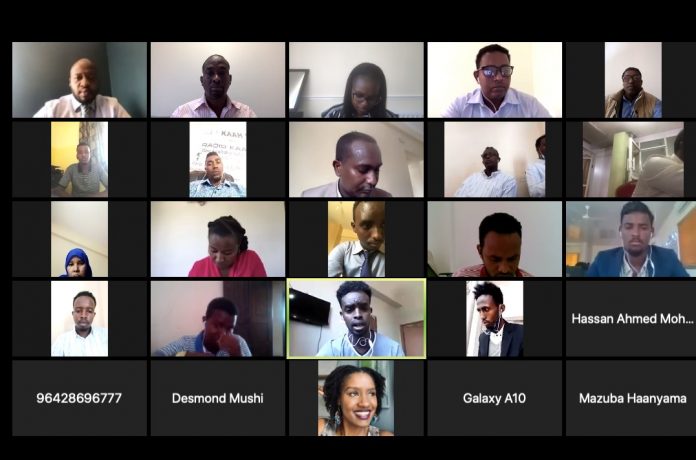
MUQDISHO, Soomaaliya, 5 Agoosto, 2020 – Shirkadda Facebook oo kaashaneysa Ururka Suxufiyiinta Soomaaliyeed (Somali Journalists Syndicate – SJS) ayaa qabtay tababar badqabka la xiriira oo ay ka faa’ideysteen in ka badan 40 weriye oo ku kala sugan guud ahaan Soomaaliya kaasoo lagu qabtay barta maqalka iyo muuqaalka ee Zoom maalintii Arbacada ee 2da Sebtembar, 2020.

Tababarkan oo cinwaankiisu ahaa ‘Sida Amni loogu Adeegsado Facebook‘ ayaa ahaa kii ugu horreeyay ee noociisa ah oo ay shirkadda Facebook u sameyso warfidiyeenka Soomaaliyeed, iyadoo ujeeddadu tahay sidii suxufiyiintu u fahmi lahaayeen habka badqabka marka ay adeegsanayaan Facebook iyagoo waajibkooda shaqo ee war-tebinta gudanaya.

“Tababarkan waa muhiim. Waxaan ku faraxsannahay in SJS uu noqday meeshii ugu horreysay ee tababar noocan oo kale marti-gelisa. Waxaan ammaanayaa kooxda ka socota Facebook ee tababarkan bixineysa oo go’aan ku gaaray inay fuliyaan tababarkan, kana rumeeyay,” ayuu yiri Xoghayaha Guud ee Ururka Suxufiyiinta Soomaaliyeed (SJS) Abdalle Ahmed Mumin, “Iyadoo ay soo dhowdahay xilli doorasho, waxaa muhiimad weyn noo leh amniga iyo badqabka suxufiyiinta Soomaaliyeed. Waxaa jirtay tusaalayaal fara-badan oo ku saabsan weriyaal barahooda Facebook la weeraray, qaar la jabsaday iyo kuwo sifo khaldan looga iyadoo khatar la geliyay xogtooda gaarka ah, sababta kaliya ee loo yeelay sidaasna waa inay yihiin warfidiyeenno soo tebinaya runta.“

Facebook waa bar muhiim u ah suxufiyiinta. Ma’ahan kaliya inay suxufiyiintu u adeegsadaan wada xiriirka aas-aasiga ah, ee xitaa waxay u adeegsadaan ururinta xogta iyo la xiriirida ilo wareedyada. Facebook bar ahaan ayaaba loo adeegsadaa warbaahin ahaan oo waxay suxufiyiintu ku daabacaan wararka maalinlaha ah ee ay soo tebiyaan. Ugu yaraan dhammaan xarumaha warbaahinta ee Soomaaliya ka hawlgala ayaa adeegsada barta Facebook si ay xogta markaa ka dhacaysa dalka u gaarsiiyaan dadweynaha Soomaaliyeed oo ay ku jirto xogta ku saabsan Covid-19 iyo arrimaha kale ee bani’aadannimada.

Inagoo ku hadleyna magaca dhammaan warfidiyeenka Soomaaliyeed, ururka SJS wuxuu bogaadinayaa dadaalka shirkadda Facebook ay ugu jirto inay hagaajiso habka badqabka isticmaalayaasha Facebook oo ay ku jiraan suxufiyiinta. Waxaanu rajeynaynaa in mustaqbalka SJS iyo Facebook sii wadi doonaan ka wada-shaqeynta horumarinta badqabka suxufiyiinta Soomaaliyeed ee dhanka Facebook.